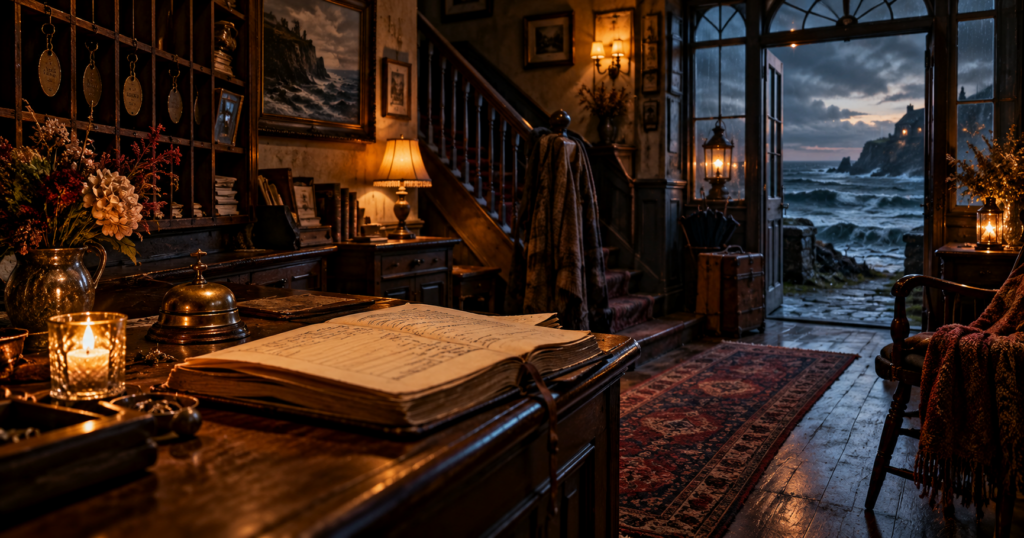
Mrs Calder’s October Guestbook

Mrs Calder ran the Sea Lantern Guesthouse as if the British seaside had never changed. Breakfast was served from seven thirty until nine, not a minute later. Wet towels did not belong on radiators. Keys hung on brass hooks behind the desk. Guests signed a paper register even though the booking system already contained every detail. “Computers forget differently,” Mrs Calder said whenever her grandson Ben teased her about it. “Paper has better manners.” The guesthouse stood on a cliff above a narrow beach in North Yorkshire, where October storms slapped salt against the windows and tourists came specifically to enjoy bad weather from comfortable rooms. Ben had spent childhood holidays there and returned at twenty-eight after losing his job in Leeds. He told himself he would help his grandmother for a few weeks. By Halloween he was still changing beds, carrying suitcases and learning that hospitality mostly consisted of preventing strangers from noticing problems.
The October guestbook was one problem Mrs Calder would not explain. It was not the ordinary register. This book was thick, bound in dark green leather, and appeared on the reception desk every October first. Guests staying during the month were asked to sign it before leaving. On November first Mrs Calder locked it in the office safe. Ben assumed it was a sentimental tradition until he noticed names already written on pages for dates that had not happened yet. On October twenty-third, for example, the page for Halloween contained seven names. Ben recognised two from upcoming reservations. The others meant nothing to him. “Pre-filled?” he asked. Mrs Calder closed the book. “Don’t read ahead.” “Why?” “Because it encourages bad habits.” That was not an answer, but Mrs Calder specialised in answers that ended conversations. The first strange guest arrived on October twenty-sixth. His name was Harold Fenwick, one of the names Ben had seen written under Halloween. He was an elderly man with a navy suitcase and an old railway coat despite having driven himself. At check-in, Harold glanced at the green book and smiled. “Still keeping it, then?” Mrs Calder’s face softened. “Of course.”
Ben later asked whether Harold was a regular. His grandmother said, “He was.” The past tense bothered him. Harold stayed two nights, ate porridge each morning and spent hours looking at the sea. On departure he signed the October book. Ben watched over his shoulder. The signature matched the one that had already been there. Not similar. Identical, including a long downward stroke on the F. After Harold left, Ben searched his name online. A local obituary appeared. Harold Fenwick had died nine years earlier. Ben checked the guest room immediately. The bed had been slept in. A damp towel hung in the bathroom. A teacup sat beside the window. On the bedside table lay a modern car park receipt bearing that morning’s date. Ben stared at it until Mrs Calder came in carrying fresh linen. “He’s dead,” Ben said. “Yes.” “You knew?” “Yes.” “You let a dead man stay in Room Six?” Mrs Calder placed the linen on the chair. “Harold always liked Room Six.”
Ben demanded an explanation. Mrs Calder sat on the edge of the bed and looked suddenly older than her seventy-nine years. The Sea Lantern had been built in 1888. Since at least the 1920s, according to family records, people sometimes returned in October. Not apparitions exactly. They checked in, ate, slept and talked. Some knew they were dead. Others behaved as though nothing had happened. They stayed one or two nights and left before November. “Why here?” Ben asked. “Perhaps because holidays are where people practise being happy,” Mrs Calder said. “Perhaps some want one more.” The guestbook recorded them before they arrived. Ben wanted to leave. Instead, fascination kept him. Over the following days two more names from the Halloween page arrived. Edith Marlow, dead since 2004, came with a suitcase full of paperback romances. A young man named Lewis Grant, who had drowned off the beach in 1987, checked in wearing trainers that never became wet even when he walked through rain. They were not frightening. That made everything stranger.
On October thirtieth Ben looked at the Halloween page again despite his grandmother’s warning. One name remained that he recognised. Peter Calder. His father. Ben had been nineteen when Peter died suddenly from a heart attack. They had argued the week before about university, money and Ben’s decision to move away. Their final phone call ended with Ben saying, “Fine, do what you want,” and hanging up. Grief turned those six words into something enormous. For nine years he had replayed them. Mrs Calder found him staring at the page. “You knew,” he said. “I knew the name was there.” “Has he come before?” “No.” “Why now?” She shook her head. “The book doesn’t explain itself.” Halloween arrived with rain hammering the conservatory roof. By evening every normal room was occupied. Ben remained near reception, pretending to work. Nine o’clock passed. Ten. At eleven fifteen he told himself the name might not mean arrival. Perhaps the book could be wrong.
At eleven thirty-two the front door opened. Peter Calder walked in carrying the battered brown holdall Ben remembered from family holidays. He looked exactly as he had at fifty-two: thinning hair, red scarf, reading glasses tucked into his shirt pocket. Ben could not move. Peter looked at him and said, “You grew the beard, then.” It was such an ordinary sentence that Ben laughed and cried at the same time. They sat in the breakfast room until nearly dawn. Peter did not explain death. He seemed unable or unwilling to describe where he had been. Instead, they discussed football, Ben’s failed job, Mrs Calder’s stubborn refusal to replace the boiler, and the argument they had carried unfinished for nine years. “I wasn’t angry when I died,” Peter said. “If that’s what you’ve been carrying.” “You sounded angry.” “I was your dad. I sounded angry most Tuesdays.” Ben laughed again. At six in the morning Peter stood. “Time.” He signed the October guestbook. The signature matched the one already there.
Ben followed him outside. Rain had stopped. The sea below was grey in first light. At the gate Peter hugged him once, tightly. “You don’t have to stay here because you think leaving means abandoning us,” he said. Then he walked down the cliff road and disappeared around the bend. On November first Mrs Calder locked the guestbook away. Ben stayed at the Sea Lantern until Christmas, then accepted a job in York. He visited often. Years later, after Mrs Calder died and the guesthouse passed to him, Ben found himself behind reception on the first morning of October. He opened the safe. The green guestbook lay exactly where his grandmother had kept it. He placed it on the desk. For several minutes he resisted looking ahead. Then he opened to Halloween. Seven names were written there. One belonged to Mrs Calder.


