Halloween Stories•Urban Legends

The Lantern on Blackwater Bridge

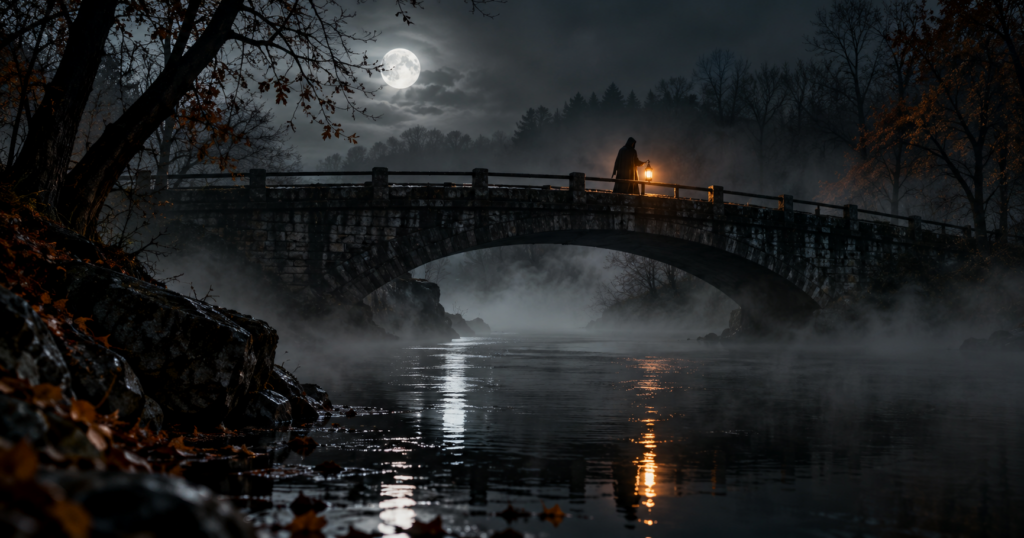
A hooded figure carrying a lantern crosses a stone bridge over dark misty water under a full moon.
◉ 0 views
JR Feed Facebook X LinkedIn WhatsApp

Everyone in Calder Vale knew the rule about Blackwater Bridge, although nobody agreed where it came from. If you crossed after midnight and saw a lantern on the parapet, you did not stop. You did not lower the window. You did not look in the rear-view mirror after reaching the other side. Teenagers repeated the rule at parties. Taxi drivers joked about it with passengers. Older residents did not joke at all. The bridge had carried the old road over the river for nearly two hundred years, a narrow stone arch with walls scarred by weather and collisions. People had died there. That was fact. The lantern belonged to the part nobody could prove. Rachel Dean had heard the story since childhood and never believed it. Her father used to slow the car deliberately when crossing, pretending to see a light until Rachel and her sister screamed. As an adult she found the legend comforting rather than frightening. Towns needed stories. They gave shape to places that might otherwise be only roundabouts, supermarkets and damp fields.

On Halloween night, Rachel finished a hospital shift at twelve twenty. A crash on the bypass had closed the newer road, forcing traffic toward Blackwater Bridge. By the time Rachel reached the turning, the diversion signs were flapping in heavy rain and her phone had no signal. She considered waiting until the bypass reopened, but she was exhausted and home was less than fifteen minutes away. She turned onto the old road. The river appeared first as a darker strip beyond the hedges. Then the bridge rose in her headlights. Rain swept sideways across the windscreen. Rachel slowed. Halfway across she saw a warm orange light on the left parapet. A lantern. She laughed aloud because the timing was too perfect. Someone had set up a Halloween prank. Probably teenagers hiding behind the wall with a camera. The lantern was old-fashioned, metal-framed, with glass panels fogged by rain. Beside it stood a man. He wore no coat. Rachel’s laughter stopped.

The man raised one hand. She drove past. At the far end of the bridge, guilt arrived before fear. She was a nurse. A person standing in freezing rain beside a river after midnight might need help. Legends did not matter. Duty did. Rachel braked, swore at herself and reversed until the man reappeared in the passenger-side window. He looked about sixty, soaked through, wearing a dark waistcoat over a white shirt. Blood ran from his hairline, though the rain diluted it across his face. Rachel lowered the window two inches. “Are you hurt?” The man leaned toward the gap. His eyes were very clear. “She’s still down there.” “Who?” “My daughter.” Rachel unlocked the doors. The man did not get in. He pointed over the parapet toward the river. Rachel grabbed the torch from her glovebox and followed him into the rain. The water below was swollen and fast. At first she saw nothing. Then her torch beam caught something pale among branches trapped near a stone support.

A hand. Rachel called emergency services as she scrambled down the muddy bank. The man with the lantern moved ahead of her, somehow steady on the slope. At river level she found a small red car upside down in the water, almost invisible from the road. One rear wheel protruded above the surface. A young woman was trapped beside it, caught in branches, face barely clear of the water. Rachel entered the river without thinking. Cold struck like a physical blow. She reached the woman, supported her head and shouted instructions into the phone tucked beneath her chin. The woman was alive, barely. Rachel kept talking to her until blue lights appeared above the bridge. Firefighters descended with ropes. Paramedics took over. Within minutes the riverbank filled with voices, lamps and equipment. When Rachel finally climbed back to the road wrapped in a thermal blanket, she looked for the older man. He was gone. She assumed police were speaking to him until an officer asked who had alerted her to the crash. Rachel described the man. The officer’s expression changed. “There was only one person in the vehicle,” he said.

“No, her dad was here.” The officer asked for the description again. Two days later a detective visited Rachel at home. The rescued woman, twenty-six-year-old Amelia Voss, would survive. Her car had left the road earlier that night, probably after skidding on standing water. From the bridge, the vehicle was almost impossible to see. Rachel’s stop had saved her life. The detective placed a photograph on the table. The man in it was younger but unmistakable. His name was Edward Voss, Amelia’s father. He had died eleven years earlier on Blackwater Bridge after stopping to help at another accident. A lorry struck him in poor visibility. According to witnesses, Edward had carried an old camping lantern in his car because the bridge had no lighting at the time. After his death, local sightings of the lantern became part of the existing legend. Rachel asked why the legend warned people not to stop. The detective gave a tired smile. “People like frightening versions.”

That answer stayed with her. She researched the bridge and found newspaper stories going back decades. Most repeated warnings about a ghostly lantern luring drivers toward the edge. But older reports told a different story. In 1912, a lamplighter named Joseph Crewe drowned after trying to rescue a coach passenger from the river. During wartime blackouts, residents claimed a light sometimes appeared before accidents. In 1963, a motorcyclist said a lantern-bearing figure warned him about a collapsed wall ahead. The story had changed because fear travelled better than gratitude. The following Halloween Rachel returned to Blackwater Bridge before midnight. The council had installed barriers after Amelia’s crash, along with reflective signs and a new emergency phone. Rachel stood beside the parapet holding a small battery lantern. She felt foolish but did it anyway. A car approached, slowed, then passed. Another followed. At twelve seventeen, Rachel saw a light on the opposite side of the bridge. Not her reflection. Another lantern. A man stood beside it. Edward Voss raised one hand. Rachel raised hers in return. Then he pointed downriver. Rachel turned immediately. Far below, a kayaker clung to a tree branch in the dark water.

Keep reading

More from this category