December 9 – The Winter Goddess Awakens

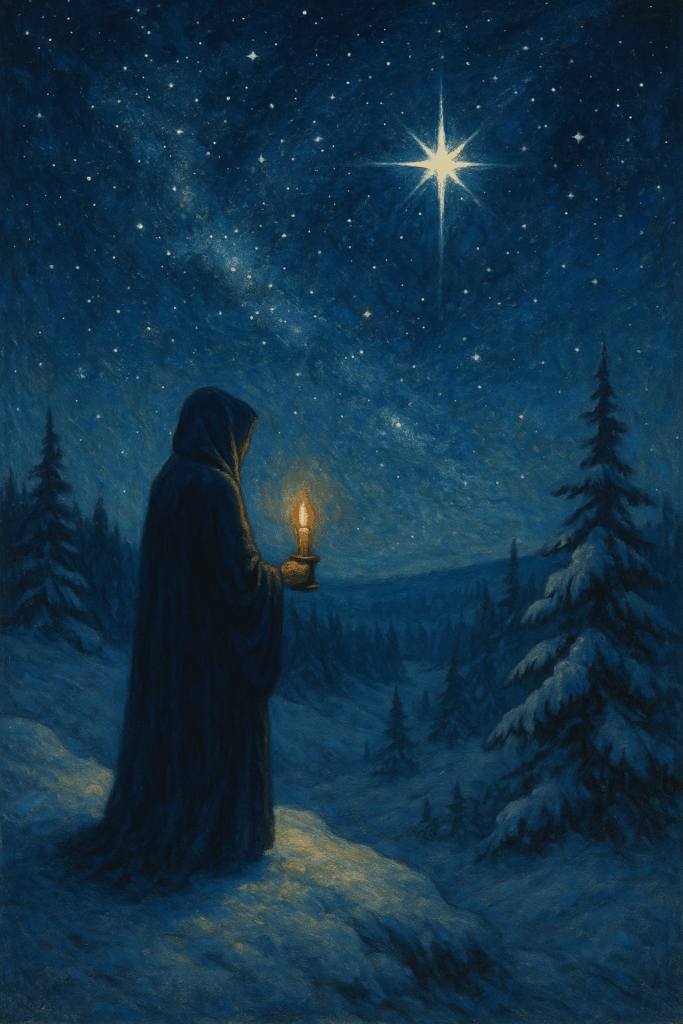
The ninth day of December arrives wrapped in frost and silence. The long nights deepen, the stars burn bright over a sleeping world, and somewhere in that vast stillness, a sacred stirring begins. The Winter Goddess Awakens — she who has reigned unseen through the season of descent, she whose breath is the frost and whose dream is the snow. Today we honor her many forms: Danu, mother of flowing waters and hidden life; Skadi, huntress of ice and mountain; Frau Holle, ancient matron of hearth and snow; and all goddesses who embody the mystery of winter’s womb — the power that conceals in order to preserve.
This is not an awakening of sudden light, but a gentle rising within darkness. It is the slow pulse of the earth as it turns toward renewal, the quiet awareness that life endures even in slumber. The Winter Goddess is not a goddess of death, as some might believe — she is the keeper of gestation, of sacred stillness, of transformation beneath the frozen surface. To awaken her is to awaken our own understanding of patience, endurance, and the beauty of hidden growth.
In ancient Celtic lands, Danu was known as the Great Mother, the flowing essence from which all life springs. Though her rivers freeze in winter, her spirit continues to nourish the unseen roots beneath the snow. She is the undercurrent that never ceases — a reminder that creation is not limited by season. Danu’s gift in winter is faith: the assurance that even when the surface appears still, the sacred current of becoming continues beneath. To honor her on this day, one might pour fresh water upon the earth or into a bowl on the altar, whispering gratitude for the life that rests unseen. The reflection in the water mirrors her eternal patience.
From the North comes Skadi, the Norse goddess of winter, mountains, and the hunt. She strides through the snow with steady strength, her eyes as cold and clear as the northern sky. Skadi teaches independence and resilience — she is the one who walks alone, yet never lonely. Her power is found in self-sufficiency and the embrace of solitude. To honor Skadi is to walk into the cold willingly, to find peace in silence, and to respect the wildness of nature. Those who light a candle for her may adorn their altar with pinecones, snowflakes, or a small stone taken from the mountainside. Skadi’s presence is not gentle, but it is just. She reminds us that the cold is not cruelty — it is clarity.
In the Germanic lands, Frau Holle (also known as Hulda or Holda) rules this time. She shakes her feather bed in the heavens, and her falling feathers become snow upon the earth. She is the grandmother spirit, the hearth’s protector, the keeper of spinning and weaving — and of moral balance. Her myth teaches that diligence, kindness, and care for one’s duties are rewarded, while neglect and cruelty bring misfortune. In her dual aspect, she blesses the good and corrects the careless, embodying the winter’s wisdom that rest and reflection must be earned through virtue and balance. To honor Frau Holle today, one might bake bread or sweep the hearth, offering a gesture of gratitude for the blessings of home and order. Domestic work, performed with reverence, becomes sacred ritual.
These goddesses, though different in name and myth, share a single truth: the Winter Goddess is the eternal mother who both nurtures and disciplines, comforts and challenges. Her awakening does not shatter the silence; it deepens it. She moves beneath the snow like a whisper, a reminder that creation is born of stillness, not haste. When we awaken her within ourselves, we awaken our own inner wisdom — the capacity to hold darkness without fear, to nurture what has not yet come into being, and to find divinity in quiet perseverance.
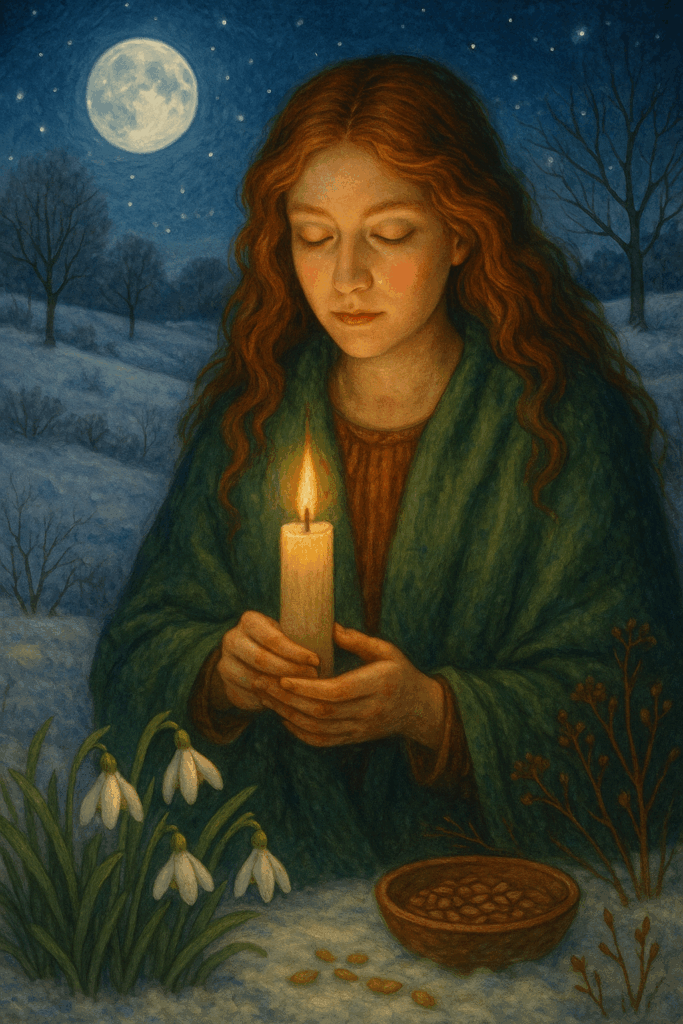
To commune with her, begin by creating a Winter Shrine — a simple altar dressed in white, silver, and deep blue. Place upon it symbols of her domains: a bowl of snow or water, a pine branch, a candle of pure white, and perhaps an image of the moon or a small mirror. Light the candle and say softly:
“Mother of frost and keeper of rest,
Stir now within my heart, O blessed guest.
In your silence, I find my song;
In your darkness, I am strong.”
Sit in stillness, watching the candle’s flame reflect upon the snow or water. Allow your thoughts to slow, your breath to deepen. In that quiet, you may sense her presence — a cold yet comforting touch, a weight of serenity that descends like snowfall. This is her gift: peace that arises not from escape, but from surrender to what is.
You may also call upon her through craft and creation, for the Winter Goddess governs all acts of making that connect the hands to the sacred. Knit, weave, carve, or bake something simple today, infusing each motion with prayer. These domestic and creative acts are offerings in her honor, for she is both creator and destroyer, spinner of fate and tender of seeds. To make something by hand in her name is to mirror her divine craftsmanship — shaping life from stillness, warmth from cold.
Another form of ritual devotion is through dreamwork. The Winter Goddess often speaks through dreams, for her realm is that of the subconscious and the fertile dark. Before sleeping tonight, place a sprig of evergreen or a silver charm beneath your pillow and whisper an invocation:
“Lady of snow, keeper of the veils, open my dreams to your wisdom.”
You may awaken with messages, symbols, or visions — gifts from her realm. Record them, for they often hold guidance for the coming solstice.
Spiritually, this day invites us to reflect on how we treat the “winter” within our lives — those times when growth slows, when energy fades, when silence takes the place of song. Our culture often fears such periods, urging constant productivity and light. But the Winter Goddess teaches that darkness is not a void but a womb. Rest is not idleness but sacred incubation. Just as the earth regenerates in her sleep, so too must we honor our need for quiet and renewal. To embrace our inner winter is to honor the divine feminine that dwells in stillness — the aspect of the Goddess who dreams the world anew.
The awakening of the Winter Goddess is also the awakening of reverence for nature’s cycles. She is the spirit of every frozen river, every snow-covered hill, every quiet night filled with stars. When you walk through the winter landscape, she walks beside you — not as a separate being, but as the breath within your own. Her whisper says, “Be still. The world is not dead. It is dreaming.” When we learn to listen to that whisper, we rediscover the sacred pulse beneath the frozen silence.
You may close your ritual with a gesture of gratitude. Offer a cup of milk, wine, or warm water to the earth, saying:
“To the Mother of the Cold, I give thanks.
May your rest be deep, your dreams fertile,
And your blessings flow through all the worlds.”
Leave it beneath a tree, in snow, or upon your altar overnight. The offering symbolizes your partnership with the season — a covenant between human and goddess, light and dark, stillness and motion.
The Winter Goddess does not demand worship through grandeur but through awareness. She is found in the hush of falling snow, in the patient flicker of a candle, in the tender act of tending one’s home or heart. Her awakening is quiet yet profound, reminding us that even now, in the coldest time, life prepares for rebirth. Within her stillness lies the seed of all creation.
On this day, may you feel her presence in your breath, your dreams, your home. May Danu’s waters flow beneath your soul, Skadi’s clarity steel your spirit, and Frau Holle’s wisdom bless your hearth. For the Winter Goddess has awakened — and through her awakening, so too does the light within begin to stir.