December 13 – The Wreath and the Wheel

By mid-December, the air is crisp with expectancy. The sun lingers only briefly before retreating again, and yet within the growing darkness, the hum of anticipation builds. The solstice draws near, and with it, the promise of return. On December 13, we celebrate The Wreath and the Wheel — a meditation on circles, time, and sacred cycles. The wreath, a symbol so common in winter that it adorns doors across the world, is far more than decoration. It is the embodiment of the eternal — the endless turning of life and death, night and day, creation and rest. To contemplate the wreath is to contemplate the Wheel of the Year itself, and the ancient truth that what ends must always begin again.
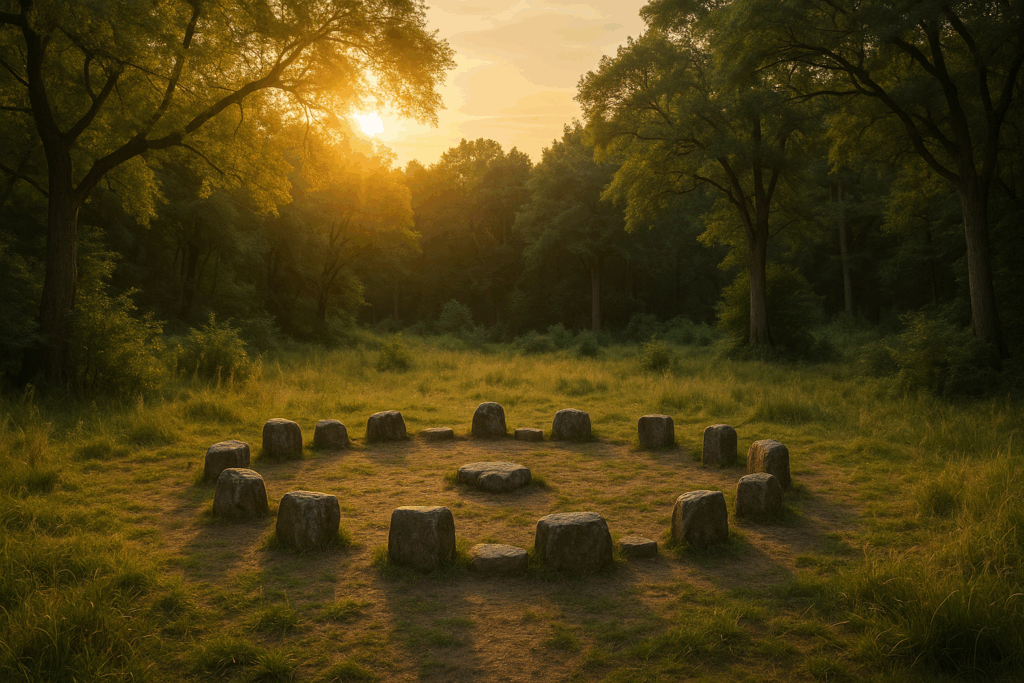
In pagan spirituality, the circle is the holiest of shapes. It is the shape of the sun and moon, of the horizon, of the cycles that govern all existence. It has no beginning and no end, and thus represents the infinite continuity of the divine. The Wheel of the Year, as we know it today, is the modern expression of this truth — an echo of ancient agricultural and celestial observances woven into the fabric of the seasons. It reminds us that the year is not a line we travel but a spiral we dance. Every solstice, every equinox, every turn of the wheel is a moment of balance between opposites — life and death, growth and decay, sowing and harvest, light and dark.
The wreath is the domestic manifestation of this cosmic principle. Fashioned in a circle, it mirrors the wheel in miniature. Traditionally made from evergreen boughs — pine, fir, cedar — it carries the promise of endurance, the persistence of life even in the heart of winter. Its roundness symbolizes wholeness and unity; its greens whisper of renewal. When hung upon a door or window, it becomes a charm of protection and blessing, ensuring that the cycles of the year continue harmoniously within the home. The wreath and the wheel are thus reflections of each other — one hanging in the heavens, the other upon our threshold, both turning through eternity.
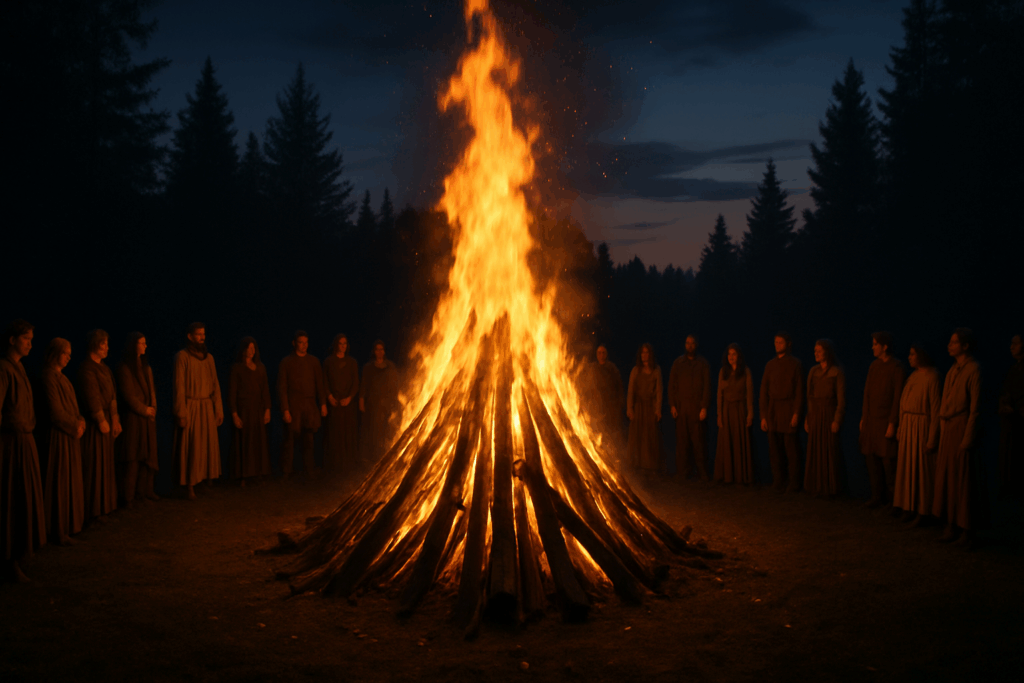
In the earliest pagan traditions of northern Europe, circular symbols were central to winter rites. The sun wheel, or hjól, was crafted from wood and lit aflame to honor the rebirth of the sun at Yule. Rolled down hillsides or spun upon poles, it represented the movement of the solar chariot through the sky, promising that the long nights would soon wane. The evergreen wreath evolved from this symbol, capturing the essence of that fiery wheel in a gentler, more domestic form. Where once the wheel blazed upon the hills, now the wreath glows with candlelight in the home — a circle of green in place of flame, but the meaning endures: life returns, always.
To honor The Wreath and the Wheel, begin by contemplating the circles in your own life. Where do you see beginnings and endings blending into one another? What lessons have come full circle this year? What parts of yourself are ready to complete their turning, and what seeds lie waiting to be planted in the next cycle? The wheel does not rush — it turns with patience and grace. So too must we learn to trust the rhythm of our own becoming.
If you are inclined toward craft and ritual, today is an ideal time to create your Solstice Wreath. Gather evergreen branches — pine for cleansing, fir for endurance, cedar for protection. You may also add holly for courage, ivy for resilience, and mistletoe for blessing. Weave the boughs into a circle, binding them with red or gold ribbon, colors of life and light. As you work, focus on the intention of renewal. Each branch you add is a prayer, each twist of ribbon a promise. Whisper softly as you weave:
“Circle of life, circle of light,
Turn again through longest night.
Bless this home, this heart, this year,
With love enduring, bright, and clear.”
When the wreath is complete, place it upon your door or above your altar. You may also adorn it with four candles — one for each quarter of the year, or each element: Earth, Air, Fire, and Water. Lighting them throughout the season honors the unity of all things, the eternal wheel in motion.
If you prefer a contemplative practice, meditate upon the Wheel of the Year itself. Envision it turning slowly before you, each spoke representing a sabbat: Yule, Imbolc, Ostara, Beltane, Litha, Lammas, Mabon, and Samhain. See how each flows into the next, none separate from the other. There is no true death, only transformation. You are part of this wheel — your breath, your aging, your moments of loss and joy all part of the same divine motion. The ancients knew this truth intimately. To them, to resist the cycle was to resist life itself. When we remember that time is circular, not linear, we free ourselves from the fear of endings.
In ritual terms, today’s energy is about alignment — placing oneself in harmony with the natural rhythm of existence. You may choose to anoint yourself with a few drops of solar oil — orange, cinnamon, or frankincense — while tracing a small circle upon your heart. As you do, whisper: “I move with the wheel; I am whole within its turning.” Feel yourself becoming part of the eternal dance, your spirit flowing through the cycle of the seasons like the sun across the sky.
The wreath also carries deep symbolism of unity and community. In ancient villages, communal wreaths or garlands were created and hung in gathering halls, temples, or around central fires to signify the interconnectedness of all who lived under the same sun. Each person contributed something — a sprig of herb, a ribbon, a charm — symbolizing their part in the greater whole. You may wish to revive this tradition by creating a family or coven wreath. Invite each member to add something meaningful: a dried flower, a written wish, a small crystal. In this way, the wreath becomes a living emblem of collective hope, binding hearts together as the year turns.
Spiritually, the Wreath and the Wheel remind us that all life is cyclical. The winter we endure now is not separate from the summer we remember — both are threads in the same tapestry. Every joy carries the seed of sorrow; every sorrow holds the promise of renewal. The pagan path invites us to embrace this truth, not with resignation but with reverence. To walk in harmony with the wheel is to accept that every ending contains a blessing, every night a dawn. The wreath upon the door is not a denial of winter but a celebration of its necessity — for without darkness, there can be no return of light.
For those who walk the witch’s path, the wreath may also serve as a protective charm. Its circular form wards off negative energies by redirecting them, ensuring that only harmony may enter. You can empower your wreath by sprinkling it with a little saltwater or by passing it through the smoke of cedar or sage. As you do, visualize a sphere of light surrounding your home, its boundaries soft but strong, like the eternal circle itself. This act transforms the wreath from decoration into sacred guardian.
As night falls on December 13, take a final moment to gaze upon your wreath or the image of the wheel. Notice its symmetry, its peace. Everything moves in balance, even when unseen. The sun’s path, the moon’s cycle, the turning of the earth — all echo in the circle you hold before you. The same rhythm beats within your heart. Whisper a prayer to the Wheel:
“Great Circle of Being,
I honor your turn.
Through shadow and flame,
May I always return.”
Let the words linger like breath upon glass. In them lives the truth of the season: nothing is lost, only transformed. The wheel will turn again, and the green will rise once more.
The Wreath and the Wheel remind us that winter is not an end but a renewal — the necessary pause between one spiral and the next. By honoring the circle, we honor the eternal dance of creation. The wreath upon our doors becomes a portal through which the sun may find its way home, and the wheel within our spirits turns quietly onward, forever in tune with the pulse of the universe.