December 12 – Chant of the Longest Night

There comes a moment before the solstice when even the stars seem to hold their breath, and the darkness feels endless yet sacred — a womb of infinite potential. On December 12, we enter that threshold of deep stillness and dedicate this day to the Chant of the Longest Night, a poetic meditation on darkness as the divine womb from which all light is born. This is not a night to resist or fear the dark, but to sing to it, to feel its quiet power moving through our bones and dreams. The chant is both a song and a silence — an offering to the great void, to the cosmic mother who gestates creation in her infinite depths.
Before there was light, there was darkness. Before there was sound, there was silence. In this primordial stillness, all things existed in potential — unformed, infinite, divine. Pagan cosmologies across the world remember this mystery. The Norse spoke of Ginnungagap, the yawning void between fire and ice from which the first beings arose. The Celts told of the Cauldron of Cerridwen, the vessel of transformation in which life and wisdom are reborn. In Egypt, Nun, the endless black waters, held the sun’s seed before it first rose. Darkness, in all these myths, is not the enemy of light but its mother. To honor the darkness is to honor creation itself.
The Chant of the Longest Night is a song of surrender and reverence. It is not sung in fear but in faith. When the outer world grows cold and empty, the inner world awakens. The soul, like the earth, turns inward to rest and renew. To chant in the darkness is to speak to that ancient pulse that lives beneath all things — to say, “I remember you. I trust you. I know you hold me.” This is the essence of the practice: not to call light into being prematurely, but to rest in the dark’s fertile embrace and let it reveal its quiet magic.
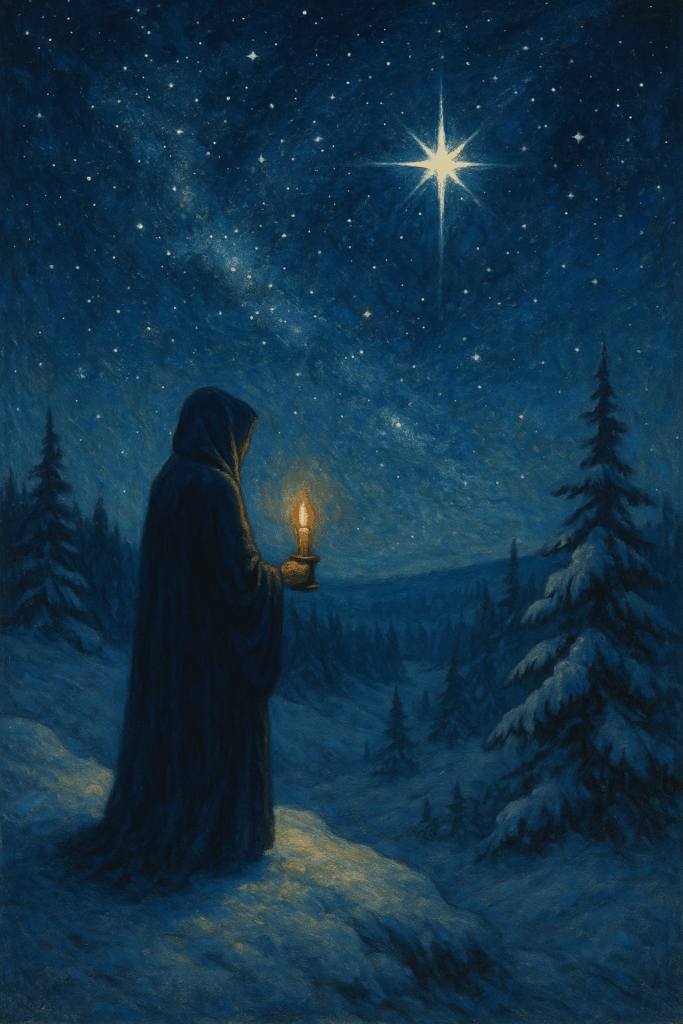
To begin, prepare a space for silence and reflection. Dim the lights until the room glows only with the faintest candlelight or none at all. Allow your senses to expand into the dark. Sit or lie comfortably and breathe deeply. Feel the rhythm of your breath as a tide — in and out, light and dark, life and rest. Then, begin your chant. It need not be elaborate; even a single phrase repeated slowly can open the door to transcendence. You might whisper:
“Out of darkness, light is born.
In silence, I find my song.”
Let the words flow naturally, carried by your breath. Feel the vibration in your chest — the flame of life glowing beneath the surface. The chant may rise and fall, grow louder, then fade into quiet. You are not performing; you are communing. The chant is not for others to hear but for the darkness itself. It is a call to the divine womb, to the mystery that births galaxies and dreams alike.
As you continue, imagine yourself floating in an infinite sea of black velvet — not oppressive, but gentle and warm. Each breath is a ripple that expands outward, touching the edges of the cosmos. You are the child within the Mother’s womb, safe, held, and waiting to be reborn. This vision reconnects you to the cycles of life and death, reminding you that the dark is not an ending but a beginning. The Chant of the Longest Night thus becomes a sacred lullaby sung by both the soul and the cosmos to each other.
If you practice in a group or coven, you may wish to turn this meditation into a circle of sound. Gather in darkness, perhaps around an unlit candle or bowl of water to represent the cosmic void. Begin with silence, letting each person listen to the stillness. Then, one voice begins a simple tone or word — perhaps “Mother,” “Night,” or “Return.” Others join when moved, weaving a soundscape that rises like wind and falls again into hush. No rhythm is needed, only intuition. The voices become one body of sound, echoing the breathing of the earth itself. When the chant fades, all remain in silence, feeling the resonance that lingers — the living vibration of creation within and without.
The spiritual purpose of this ritual is to reconcile with darkness. In a world that often fears the night, this practice reclaims it as sacred. The dark is the realm of rest, regeneration, and mystery. It is where seeds take root, where dreams gestate, where transformation begins unseen. To embrace it is to surrender control — to admit that not all growth is visible, and not all answers are immediate. The chant helps us let go of the need for light long enough to discover that the dark, too, is divine illumination in another form.
This practice can also become deeply personal healing work. Each of us carries our own shadows — grief, fear, regret — and often we seek only to banish them. But through the Chant of the Longest Night, we invite these shadows to sit beside us. We acknowledge them as teachers rather than foes. As you chant, you may wish to whisper to your shadows: “I see you. I thank you for what you have taught me. Rest now in peace.” The sound of your voice will soften their edges. What once seemed heavy may dissolve into understanding. The darkness within becomes not a void but a cradle — the same cradle that holds the stars.
Throughout history, chanting and toning have been used to align human consciousness with cosmic order. The Om of Hindu tradition, the Gregorian chants of medieval mystics, and the keening of Celtic bards all stem from the same realization: that vibration bridges heaven and earth. The Chant of the Longest Night continues this lineage. Its purpose is not merely sound, but resonance — the attunement of body, breath, and spirit to the great hum of existence. When you chant into the darkness, you join the universe in its own song of becoming.
If you wish to enhance the ritual, you may work with symbols of the dark: a black candle representing the fertile void, a piece of obsidian or onyx for grounding, or a bowl of water to reflect unseen depths. As you chant, gaze softly into the water. You may see ripples, shadows, or images forming — messages from the subconscious or the spirits that dwell within the silence. Trust what comes. The language of the dark is not linear; it speaks through symbol and feeling.
When the chant concludes, do not rush to relight the lights. Sit for a time in the lingering stillness. Feel how your perception has changed — how the dark now feels alive, nurturing, even holy. You may notice that when you finally light your candle or open your eyes, the flame seems brighter than before, the light more precious for having been preceded by silence. This is the essence of the solstice mystery: light is not meaningful without darkness, and the soul cannot be reborn without descent.
As you close your ritual, speak words of gratitude to the night:
“O Holy Dark, cradle of stars,
Womb of all beginnings,
Keeper of mystery and peace —
I honor your stillness.
In your silence, I remember who I am.”
Leave your candle burning safely for a while, or let your chant echo softly into dreams. Tonight, you may find your sleep deeper, your dreams more vivid. The darkness, now befriended, opens itself to you. You walk its halls not as a stranger but as a child returning home.
The Chant of the Longest Night is more than a meditation — it is a restoration of balance. It reminds us that light and dark are not adversaries, but partners in the eternal cycle. The womb of the Goddess is the same as the night sky above us: vast, quiet, and full of unborn stars. In learning to honor the dark, we reclaim our wholeness. We learn to trust the silence between heartbeats, the pause between breaths, the mystery between years.
On this December night, as the year nears its deepest point, may your chant rise like smoke into the sacred dark. May your voice find harmony with the unseen music of the cosmos. And may you come to know, with every fiber of your being, that darkness is not the absence of the divine — it is its beginning.