December 10 – A Solstice Candle for Hope

By the tenth of December, the nights feel almost endless. The air has grown sharp with frost, the sun’s light brief and low. Yet even as the shadows deepen, a quiet anticipation begins to stir within the soul — a soft awareness that the great turning is near. On December 10, we kindle A Solstice Candle for Hope, a simple but profound act of light-making that honors the faith that sustains us through darkness. It is a day to prepare not only our candles and wicks, but our hearts, for the rebirth of the sun to come. Hope, like flame, begins small — a single spark against the vastness of night — yet it is enough to call back the dawn.
Hope has always been the unseen thread woven through the fabric of winter’s lore. For our ancestors, the solstice was not a day of immediate warmth but of patient faith. They gathered around fires that seemed tiny beneath the infinite dark sky, whispering prayers that the sun would return. And it always did. Each year, the people watched the same miracle unfold — the moment when the sun, after reaching its lowest point, began to climb again. That turning was a cosmic promise: that life, however dimmed, would never vanish completely. Thus, every candle lit in this season is an echo of that ancient assurance — that even in our deepest shadows, there is light waiting to rise.
The Solstice Candle is more than decoration; it is a vessel of intention. When we light a candle in honor of the coming light, we are participating in an act of creation as old as the world. The flame we kindle symbolizes our partnership with the returning sun — we nurture its reflection on earth while the heavens rekindle their own fire. The candle becomes a miniature sun, its golden radiance a reminder that divinity burns within us just as surely as it burns in the sky. Every flicker is a breath of faith; every spark a declaration that light will prevail.
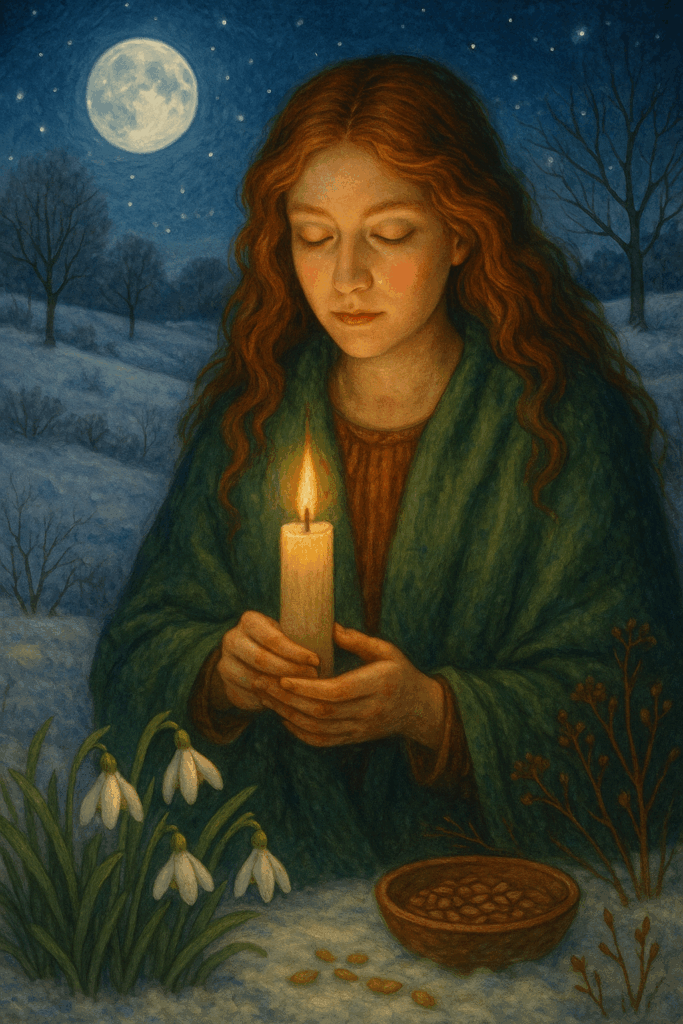
To craft your Solstice Candle, begin by choosing one that speaks to your heart. Traditionally, gold or deep red is used, symbolizing the life force of the sun and the sacred blood of rebirth. White or cream may also be chosen to represent purity and new beginnings. Before lighting, the candle can be dressed with oils or herbs associated with renewal and endurance — cinnamon for vitality, rosemary for remembrance, orange peel for solar energy, and frankincense for divine connection. As you anoint the candle, speak softly your intentions for the waxing light. What do you wish to grow as the days lengthen? What dreams, buried like seeds beneath winter soil, are ready to awaken?
When ready, create a quiet space for your ritual. Dim the lights and face east — the direction of dawn, of beginnings. Take a moment to breathe deeply, feeling the rhythm of the earth beneath your feet. When you strike the match, do so with mindfulness. Watch the tiny flame emerge, fragile yet resolute, and say aloud or in your heart:
“I kindle this light in the heart of darkness,
A promise of dawn, a prayer of renewal.
As the sun shall rise, so too shall hope.”
Let the candle burn as you meditate upon its glow. Notice how it moves — how even the slightest breath causes it to bend and recover. The flame is alive, responsive, sensitive, yet enduring. It teaches us that hope is not unshakable stillness, but resilience. True hope wavers, flickers, even dims — but it never dies. Like the solstice sun, it rests only to rise again.
In this meditation, allow yourself to feel the warmth of the candle’s light upon your face. Imagine it entering your heart, rekindling the quiet places within you that have grown weary or dim. Each breath you take feeds the flame; each exhale releases what weighs you down. This is the heart of candle magic — the communion between breath and fire, human and divine. The flame becomes a bridge between the inner and outer worlds, between what has been lost and what may yet be born.
You may wish to write upon a small piece of paper a single word that embodies your hope for the coming year — “healing,” “courage,” “renewal,” “peace.” Fold it gently and place it beneath the candle’s holder as it burns, allowing the flame to sanctify your intention. When the ritual is complete, you may keep the candle for the solstice itself, relighting it on the longest night to guide the sun’s return.
The practice of lighting candles for hope has roots deep in humanity’s spiritual memory. Long before Yule logs or solstice feasts, people kept sacred fires burning through the night to symbolize endurance through hardship. In some ancient northern tribes, it was believed that if the hearth fire went out before dawn on the solstice, the year ahead would falter in fortune. To prevent this, they tended their flames with songs and offerings, feeding it with evergreen branches and fragrant resins. In the Mediterranean world, candles were lit in honor of the sun gods — Helios, Apollo, Mithras — whose light embodied divine renewal. These ancient echoes remind us that the Solstice Candle is not merely symbolic, but a living thread that connects us to those who came before, all of whom looked to the same sun and trusted in its return.
Yet this ritual is not bound to a single tradition. Hope transcends borders, pantheons, and names. Whether we call upon Brigid, Amaterasu, Sol Invictus, or the nameless Spirit of Light itself, we participate in the same sacred act — the affirmation that even in darkness, life persists. When we light the Solstice Candle, we become co-creators with the divine, keepers of the promise that has guided humanity for millennia: the promise that light always returns.
Beyond ritual, the Solstice Candle also invites us to embody its teaching in daily life. How might we be candles in the world? How can we offer light to others during this long season of cold and uncertainty? Perhaps by simple acts — a word of kindness, a meal shared, a gift given with warmth. Hope is not only a feeling; it is a practice. Each gesture of compassion becomes a spark that carries light through the human web. In this way, our individual flames join a greater fire, a constellation of hope that burns across hearts and homes alike.
You may also extend the candle’s energy outward by anointing your doorways with a drop of melted wax or by carrying the candle’s flame from room to room, blessing each space with warmth and light. As you do, whisper:
“May this light banish despair,
May it bring peace to all who dwell here.”
This simple act transforms your home into a temple of hope — a place where light lives and grows.
When your ritual feels complete, allow the candle to burn safely for a time before extinguishing it gently. Do not blow it out; instead, cover it or pinch it closed, symbolizing that the light remains alive within. The candle will await the solstice, ready to be relit when the sun stands still and begins its ascent. Between now and then, let its presence remind you daily of resilience — that hope is not found in grandeur but in the quiet persistence of the smallest flame.
The Solstice Candle for Hope is a devotion not only to the returning sun but to the human spirit itself. In lighting it, we say: I will not surrender to the dark. We acknowledge that while night may be long, it is never final. The flame on our altar, like the spark in our hearts, is eternal. Even when unseen, it waits — just as the sun waits beneath the horizon, ready to rise.
So light your candle, and let it speak in silence. Let its glow reach the unseen places in your soul. Let it remind you that hope is not a fragile dream, but the foundation upon which the world renews itself each year. For as long as there is a single flame burning in the dark, dawn is inevitable.