December 1 – Crown of Winter Stars

When the wheel of the year turns toward the final descent of autumn and the embrace of winter’s long nights, the heavens reveal a majesty that seems to speak directly to the soul. The ancients called it the crown of winter stars — a celestial coronet that graces the cold sky with the lights of endurance, renewal, and divine reflection. Under this crown, humanity has always looked upward, finding hope in the shimmering expanse when the earth below falls silent. The first of December opens this contemplative season. It is a day to honor the night sky not as an empty void, but as a sacred temple — a place where spirit and silence commune, where every star burns as a spark of the Eternal Fire.
As the last leaves crumble to dust and frost paints the windows, the night becomes a teacher. Its depth draws us inward, away from the clamor of the world, and into the cathedral of our own consciousness. To gaze upon the winter constellations — Orion rising, Sirius gleaming like a cosmic flame, the Pleiades clustering in mystical formation — is to remember that even in the coldest months, the universe hums with divine order. Pagan traditions from the Celts to the Norse, from Egypt to Mesopotamia, revered the stars as divine intelligences, beacons of ancestral wisdom, and reflections of the soul’s journey through time. The “Crown of Winter Stars” reminds us that the heavens above mirror the sacred geometry within us.
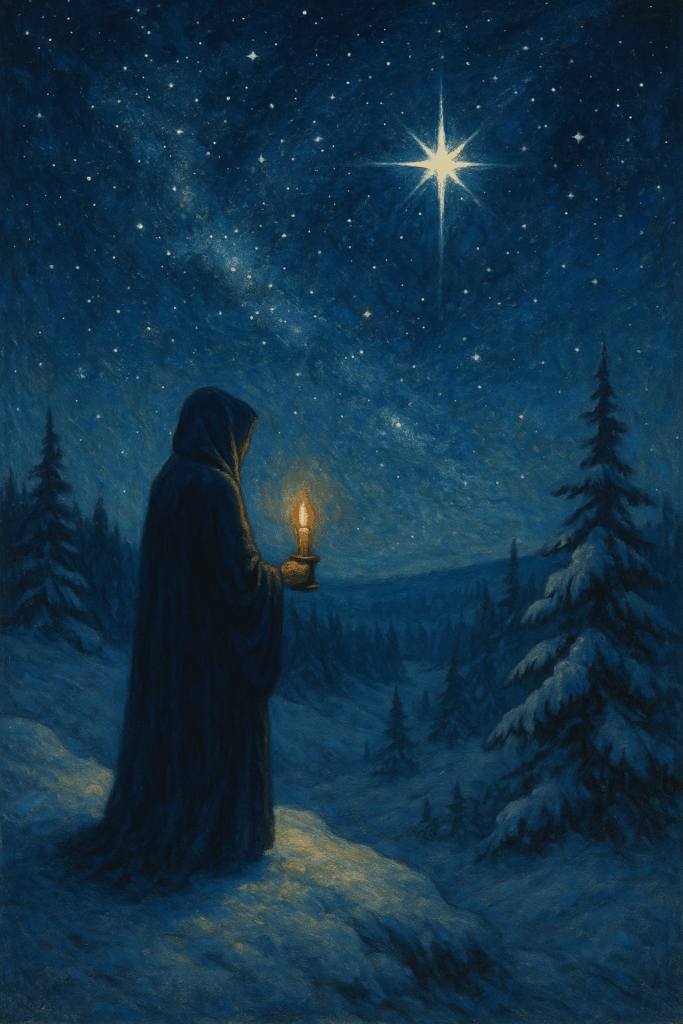
Winter’s darkness invites reflection. The long nights encourage a form of spiritual renewal that can only occur in stillness. Many modern pagans choose to mark December 1 with a night of star-gazing or meditation beneath the open sky, no matter how cold the air may be. Wrapped in a cloak or heavy shawl, one may stand beneath the infinite canopy and breathe deeply of the crystalline air, allowing the mind to quiet and the heart to expand. Each visible star can be named, thanked, or even sung to — a practice known as stellar devotion in some traditions. The ancients believed that the stars could hear, that each luminous being was alive, conscious, and responsive to prayer.
In Wiccan and Druidic thought, winter corresponds to the north — the direction of wisdom, endurance, and the unseen. The element of earth holds sway, yet in the upper air, the stars belong to spirit itself. To unite the two is to bridge the seen and unseen worlds, the human and divine. Thus, the “Crown of Winter Stars” becomes not merely a visual image, but a ritual act of alignment: to stand beneath the stars is to stand at the threshold of eternity. One feels both infinitesimally small and magnificently connected — a paradox that humbles and uplifts in equal measure.
Ancient rituals for this season often included lighting a single flame beneath the night sky, symbolizing the soul’s light reflected in the cosmic vastness. The star and the candle were seen as kin — both born of divine fire, both destined to illuminate darkness. In contemporary pagan practice, one might create a “stellar altar”: a simple outdoor or windowsill space adorned with white candles, clear quartz crystals, and silver or blue cloth. These colors and textures evoke the essence of the heavens. A small mirror may be added to represent the reflective quality of starlight, reminding us that we, too, are mirrors of the divine.
The mythology surrounding the stars in winter is vast and varied. To the Norse, the god Odin rode through the starry realms during the Wild Hunt, a spectral procession of souls that swept across the cold skies. To the Greeks, Orion’s eternal chase of the Pleiades symbolized the cycles of desire and loss. In Celtic lore, the winter stars were seen as ancestors watching over their descendants, guiding them through the darkest nights. These myths converge on a single point: the stars are eternal witnesses, bearers of memory, and guides through the shadow.
Spiritually, this night invites introspection. The darkness overhead mirrors the inner depths we must traverse before renewal. To meditate under the “Crown of Winter Stars” is to enter the sacred silence before the rebirth of light that will come at Yule. The stars become mentors in patience, reminding us that brilliance is not extinguished by distance or cold — it merely shines more clearly when the world below is still. The soul, too, glows brightest when the distractions of life fall away.
A simple ritual for this day may begin by facing north beneath the open sky or at a north-facing window. One breathes deeply, grounding oneself in the earth while opening the crown chakra — the energy center that connects us to the divine. Visualize a ring of stars encircling your head, each point of light a symbol of wisdom, clarity, and connection. Speak aloud your gratitude for the cycles of life and death, for the beauty that endures even in the stillness of winter. Offer a moment of silence, allowing your thoughts to drift upward and dissolve among the stars. When ready, whisper a wish or a prayer into the night — a seed of hope to be carried on the breath of the universe.
This practice aligns with the season’s energy of reflection and renewal. Winter teaches us that life persists even when unseen. Beneath the frozen soil, roots deepen. Beneath the still air, stars burn in ceaseless motion. Beneath our own quietude, the spirit refines its light. The “Crown of Winter Stars” is both a metaphor and a revelation — a reminder that our personal darkness is never devoid of grace, that beauty endures beyond decay, and that the divine speaks most clearly through silence.
As you close your ritual or meditation, consider journaling your impressions of the night sky. Which stars drew your attention? What emotions or insights arose in the stillness? These reflections can form a sacred dialogue between self and cosmos — a conversation older than words. Over time, you may begin to feel the rhythm of the stars not as distant fires, but as companions on your spiritual path. The night sky, in this sense, becomes the first temple — vast, unbounded, eternal.
And so December begins beneath the Crown of Winter Stars — not with noise or haste, but with reverence and quiet awakening. It calls us to remember that we are made of stardust, born of the same cosmic fires that shimmer above. Each night becomes a ceremony of remembrance, each star a guide. The temple of renewal is open to all who lift their eyes and hearts to the heavens. May its silent brilliance remind you that even in the depths of winter, the divine light endures — within you, around you, and forever beyond.