🕯️ February 5 – Candle Blessings and Kitchen Magic: Imbuing Daily Tools with Sacred Intent

By February 5th, the spirit of Imbolc has moved fully into the heart of daily life. The fires lit in honor of Brigid burn not only upon altars but in every quiet act of care and creation. The sacred and the mundane begin to weave together again, as the returning light infuses even the simplest gestures with purpose. This day — Candle Blessings and Kitchen Magic — celebrates the holiness of the ordinary and the art of imbuing everyday tools with sacred intent. It is a reminder that the flame we honor in ritual must also live in our hands, in our homes, and in the humble rhythms of living.
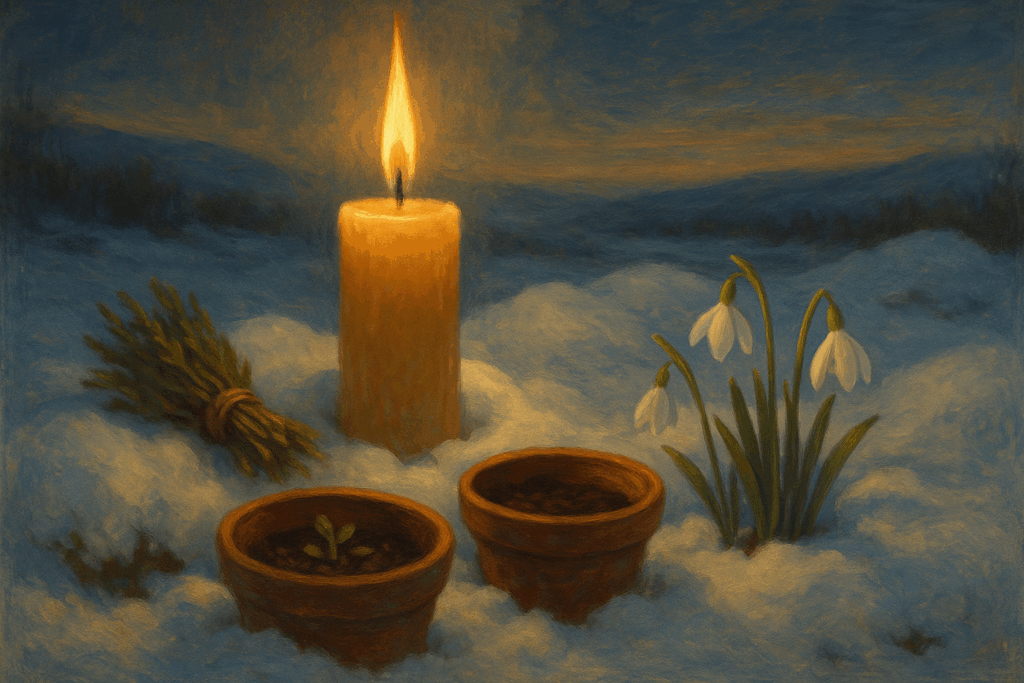
The candle, simple yet profound, is perhaps the most ancient symbol of divine light made manifest. To bless a candle is to bless a vessel of fire — a small sun that carries both warmth and wisdom. In the old ways, Imbolc was the time to bless all the candles that would be used through the year ahead. The act was both practical and mystical: practical, because candles were essential for illumination in long nights; mystical, because each flame was seen as a fragment of Brigid’s eternal fire. Every candle carried her protection, inspiration, and healing power into the home.
To perform a candle blessing, one might gather their candles — whether beeswax tapers, tea lights, or handmade votives — and arrange them in a circle upon the altar. A bowl of clean water, representing the purifying power of Brigid’s sacred wells, is placed beside them. Light a single flame in the center and speak words of consecration:
“I bless these lights in the name of the Maiden of Flame,
That they may burn with clarity and compassion,
Guide my steps through darkness,
And kindle the sacred fire within my heart.”
As the candlelight flickers, pass each candle through the smoke of incense or over the central flame, saying a quiet blessing or intention for each. These may be practical — for peace in the home, for healing, for inspiration, for courage — or symbolic of the qualities you wish to carry forward. You might anoint them with a drop of oil infused with herbs of light such as rosemary, bay, or frankincense, each herb a whisper of Brigid’s blessing. The act transforms these humble objects into guardians of intention.
But the day does not belong to candles alone. Its deeper essence lies in recognizing the magic of the hearth — the sacred power hidden in everyday life. Brigid is not only a goddess of inspiration and poetry; she is the keeper of the hearth fire, patroness of the kitchen and all acts of nurturing. To engage in kitchen magic is to honor her in the most tangible way — through the preparation of food with mindfulness, gratitude, and love.
In the old Celtic households, the hearth was the center of existence — a place of warmth, sustenance, and spiritual power. It was where meals were cooked, stories told, and prayers offered. The hearth was never allowed to go cold, for its fire symbolized the continuity of life. Today, few homes possess a central fire, but the energy of the hearth remains in our kitchens — those modern temples of nourishment where creation and transformation still take place every day.
Kitchen magic is founded on a simple yet profound truth: intention infuses matter. The energy you bring to your cooking shapes the meal as surely as the ingredients do. When you stir, you weave; when you season, you bless. A spoon can become a wand, a pot a cauldron, and each act — chopping, mixing, baking — becomes a prayer in motion. On this day, light a small candle before you begin to cook. Dedicate it to Brigid, whispering, “Bless this flame, bless my hands, and bless the nourishment born of them.”
Consider the ingredients you use not just as food but as symbols of the season. Milk, honey, oats, and herbs are all sacred to Brigid. Milk represents fertility and renewal — the first gifts of the ewes who begin to give birth at Imbolc. Honey embodies sweetness and healing. Oats are the grain of sustenance and gratitude. Together, they form a trinity of nourishment for body, mind, and spirit. A simple dish prepared with these — warm oatcakes drizzled with honey and milk, for instance — can become a sacred offering and a devotional act.
As you prepare your meal, keep your thoughts kind and focused. Ancient hearth-witches believed that the cook’s mood flavored the food as much as any spice. If your heart is calm, the meal will comfort; if your heart is joyful, it will uplift. This is not superstition but energetic truth — we are always weaving vibration into what we touch. Thus, the kitchen becomes a space of both alchemy and healing.
Blessing the tools of your craft — your cooking utensils, your cutting board, your teapot — further deepens the connection between the spiritual and the everyday. Just as candles are blessed to carry light, your kitchen tools may be blessed to carry intention. Hold each item over your altar or simply within your hands, saying:
“By flame and heart, I bless this tool,
To serve in joy and sacred purpose.
May all I create with it be filled with nourishment and peace.”
In this way, your kitchen becomes a sacred workshop — every movement, every scent, every simmering sound a part of your devotion. The act of blessing transforms labor into ritual, and the ordinary into miracle.
There is also wisdom in the candle and the kitchen together. Both represent the union of transformation and care — fire that creates, but does not destroy. The candle gives light; the hearth gives warmth. Both teach moderation and mindfulness. Fire can warm or wound, depending on how it is tended. So too our passions, our words, our actions. Brigid’s lesson through these symbols is gentle but profound: mastery of life begins with respect for the forces that sustain it.
You may also use this day to cleanse your kitchen — not in the hurried way of modern chores, but as an act of spiritual renewal. As you wipe surfaces and wash dishes, imagine you are sweeping away old energy, making room for vitality and creativity. Burn a bit of sage or cedar, or simply open a window to let fresh air flow through. When you are done, light your newly blessed candle and let it burn for a few minutes, infusing the space with light. This act harmonizes the physical and the energetic, aligning the home with the season’s renewal.
In Celtic imagination, Brigid’s presence was never confined to grand temples or distant shrines — she was most vividly felt by the hearth, at the table, in the quiet work of human hands. Her flame is the warmth that turns sustenance into communion, and her blessing is the grace that transforms necessity into joy. Each time we tend to our homes with love, we participate in her eternal rite of renewal.
As evening descends on February 5th, let the candle burn while you share a meal, even a simple one. Watch the way the light softens the faces around you, the way it reflects in glass and silver, the way it flickers gently — alive, intimate, real. This is Brigid’s flame made tangible — not a distant myth but a living spirit, shining through every act of kindness, every gesture of care, every spark of intention that turns the ordinary into the sacred.
For in the end, Candle Blessings and Kitchen Magic remind us that divinity is not found only in holy places but in holy moments — the quiet joy of nurturing, the mindful stirring of a pot, the lighting of a single flame to guide us through the dark. The goddess dwells here, in the scent of bread, in the warmth of the oven, in the light that dances upon the wall. Every home can be a temple, every meal a prayer, and every candle a star reborn from Brigid’s eternal fire.