December 24 – The Mother’s Vigil

The night before the sacred day of light’s full awakening carries a profound stillness — the kind that hums beneath the skin, alive with waiting. On December 24, we honor The Mother’s Vigil, the holy night of the Great Mother, she who labors in mystery to bring forth the reborn sun. This is a time of deep reverence, of quiet awe for the divine feminine that sustains creation through darkness and birth alike. Tonight, the goddess watches over the world as midwife to the dawn. We, her children, keep vigil with her — not in restlessness, but in loving presence.
Where the previous days celebrated fire, prophecy, and renewal, this night belongs to stillness. The Mother’s Vigil is not a time of outward magic but of inward devotion. It is the hush before the cry of the newborn light, the sacred pause between contraction and release, between the death of the old and the breath of the new. It is the cosmic womb — vast, fertile, silent, glowing with promise. Every tradition that honors the solstice knows this archetype: the Mother who gives birth to the Sun Child, the Lady of Light, the Queen of Heaven and Earth.
She is known by countless names — Danu, Frigg, Brigid, Demeter, Isis, Holle, Modron, Gaia, Theotokos, Mary — yet in all her guises, she is the same presence: the one who bears the world’s hope in her arms, who labors not only for gods but for all beings. Tonight, we honor her as the eternal mother of light, the source of all renewal, and the guardian of sacred rest.
The Stillness of Labor
The vigil begins at twilight, when the last hues of the sun fade from the winter sky. You may sense an almost physical hush in the air, as if nature itself is holding its breath. This is the hour when the Mother labors — unseen, yet felt in every pulse of the earth.
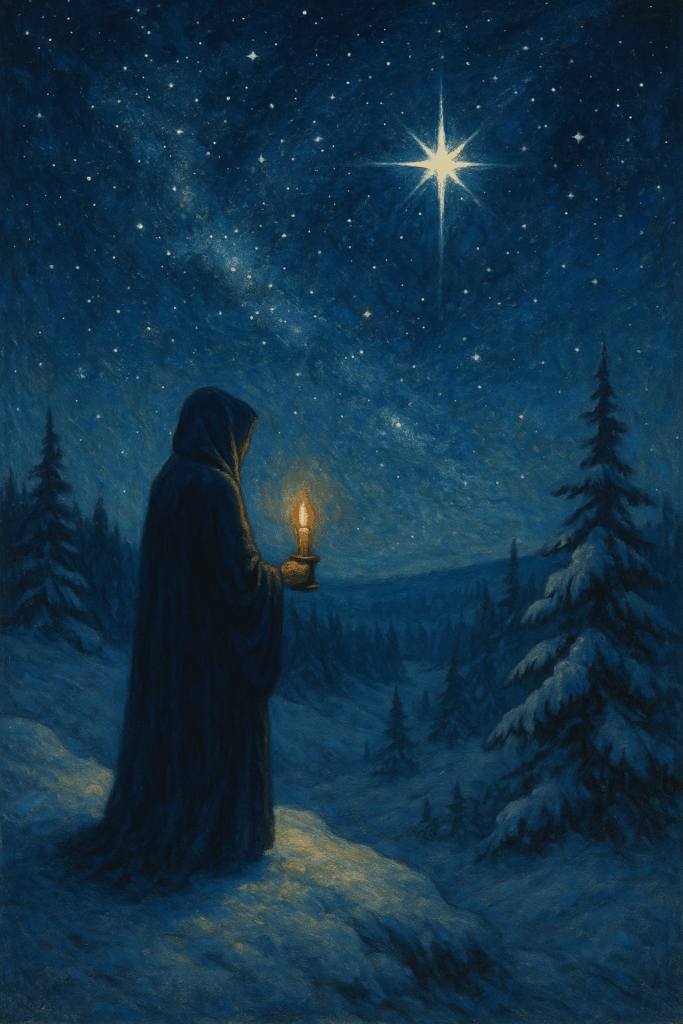
To prepare your space for this vigil, light only a single candle or oil lamp. The flame should be small, tender, symbolic of the fragile new life yet to come. Around it, place symbols of the Mother: a bowl of water for the womb, a stone or shell for the earth’s body, and perhaps a piece of bread or fruit — nourishment for her and for yourself. Adorn your altar with white cloth or evergreen sprigs, representing purity and endurance.
Sit before the flame and let the silence deepen. Breathe in rhythm with the light — a slow inhale as the flame flickers, a gentle exhale as it steadies. You are syncing yourself with the cosmic heartbeat of birth. Whisper softly:
“Mother of Night, Mother of Stars,
Keeper of seed and womb and fire,
Watch with me in this still hour.
Through your labor, life is born anew.
I am with you, in reverence and love.”
This prayer aligns your consciousness with the goddess in her aspect of birthing — not as passive creation, but as the profound power of becoming. In this moment, the divine feminine is not delicate but mighty: she holds the universe within her body, bearing pain, transformation, and light.
The Vigil of Compassion
To keep the Mother’s Vigil is to practice sacred compassion — for her, for yourself, and for all life. Take a moment to reflect upon the year that has passed. Consider the struggles, the growth, the losses, and the small acts of grace that carried you here. In each of these, the Mother has been present — holding you in her vast, unseen embrace. She does not promise ease; she promises continuity, the rhythm of breath and renewal.
You may wish to hold your hands over your heart and whisper a personal prayer:
“Great Mother, bearer of worlds,
Hold me as you hold the sun.
Let my heart be your cradle,
That compassion may be born in me anew.”
Allow tears if they come. They are offerings of water, as sacred as wine or incense. The Mother receives them all.
If you are among family or community tonight, the vigil can take the form of quiet companionship — sitting together by the hearth, lighting candles, or sharing stories of mothers and ancestors. In some old pagan households, a candle was left burning all night in the window to guide the Great Mother on her celestial journey. The light said, “You are welcome here. May your child’s first cry bless this home.”
You may continue this tradition by leaving a small flame — a tealight or lantern — in your window through the night. As you do, whisper:
“Mother of Light, your way is clear.
Rest here a while; your child is near.”
This act of hospitality connects you to generations who have honored the same mystery — from the hearths of the north to the temples of the east, to the shrines of the world’s every dawn.
The Spiritual Meaning of Birth
The Mother’s Vigil is a mirror of the inner path. Just as the goddess labors to bring forth the sun, so too do we labor in our own souls to birth light from shadow. Every creative act, every healing, every moment of courage is a form of divine birth. The process is often painful and uncertain, but within that struggle lies sacred purpose.
Tonight, meditate on what is waiting to be born within you. Perhaps it is a new phase of life, a deeper understanding, or a softer heart. Close your eyes and imagine it as a glowing seed within your womb or belly (regardless of gender, this is the universal center of creation). See it pulsing gently with golden light. Whisper:
“Child of light within me,
I guard you through the night.
When dawn arrives,
You shall awaken with the sun.”
Feel the warmth of that light spreading through your body — from the core to the heart, to the crown. You are both mother and child, both vessel and flame. The divine mystery of the Mother lives in you; her creative power flows through every breath.
The Midwives of Spirit
In myth, the Great Mother is never alone in her vigil. The spirits of birth — the Midwives of Light — stand with her. These are the divine helpers, the ancestors, the wise women, the unseen hands that catch the newborn sun and lift it to the sky. To honor them, light a second candle beside your main flame. Dedicate it to all who nurture, guide, and sustain — the healers, caretakers, and quiet souls whose work brings life to others.
You may say:
“To all who tend the flame,
I offer thanks.
May your light never fail.
May your hearts be blessed with peace.”
This gesture extends the circle of the vigil beyond yourself — into the collective spirit of care that keeps the world turning even in its darkest hours.
The Womb of the Night
As midnight nears, the vigil deepens. The world outside grows silent, and the candlelight becomes your entire universe. This is the womb of creation — the threshold where time dissolves. In this stillness, you may feel the energy of birth gathering. Some describe it as a pulsing warmth in the air; others as a subtle vibration or sense of peace. It is the Mother’s presence — vast, eternal, radiant beyond comprehension.
In meditation, imagine yourself within her — not as a separate being, but as a cell in her infinite body. Around you, galaxies swirl; within you, stars are born. She is the matrix of all existence, and you are her consciousness observing itself. This is the mystical heart of the Mother’s Vigil: to remember that all life is one life.
Sit in this awareness as long as you are able. When the first light of dawn begins to glow, open your eyes. You have kept the Mother’s watch. The child of light — the sun — is born again, and through your vigil, you have participated in that miracle.
Closing Blessing
At sunrise, lift your candle toward the window or sky and say:
“The Mother labored; the light is born.
The world is blessed; the day is new.
May love increase as sunlight grows,
And peace abide in all hearts true.”
Blow out the flame gently, as one kisses a sleeping child. Feel the warmth lingering on your lips — that is her blessing, the sacred breath of the Mother who sustains all worlds.