December 20 – Fires of the Yule Log

By the twentieth day of December, the air hums with expectancy. The longest night is nearly upon us, and the spirit of the season thickens like the scent of pine and smoke. On this sacred eve before the solstice, we honor Fires of the Yule Log — one of the oldest and most beloved winter rites, a celebration of endurance, warmth, and love. To light the Yule Log is to rekindle the covenant between humankind and the sun — an act of faith in the eternal return of light. The hearth becomes the sun’s mirror, and its flames are prayers that dance upward into the heart of night.
The Yule Log has roots stretching deep into pre-Christian Europe, where winter fires marked the renewal of the solar cycle. In the cold lands of the North, where the sun seemed to vanish entirely, lighting the sacred log was both an offering and a spell — a symbolic act to coax the sun’s return and to honor the gods of fire and light. Each spark that rose was said to carry blessings to the heavens, ensuring health, prosperity, and protection for the household through the year ahead. This was not merely a fire of survival; it was a fire of reverence.
The word Yule itself comes from the Old Norse Jól or Jul, the great midwinter festival honoring the rebirth of the sun and the turning of the cosmic wheel. The log, often chosen from oak or ash, was no ordinary piece of wood but a sacred vessel of continuity. In some traditions, the Yule Log was a remnant of last year’s fire, preserved carefully all year to ignite the new one — a symbol of life’s unbroken circle. In others, it was freshly cut from the family’s land, chosen with ritual care and blessed before being brought into the home. However it was found, the Yule Log was treated as both guest and god — greeted with song, anointed with wine, and placed upon the hearth with prayer.
To celebrate Fires of the Yule Log, one need not possess a great hearth or ancient woodland. The essence of the ritual lies not in grandeur but in intention. What matters is the lighting of flame with love and purpose — whether that flame burns upon a log, in a candle, or within the heart itself.
If you are fortunate to have a fireplace, begin by choosing a piece of wood that feels right to you. Oak, with its strength and solar nature, is traditional; pine, birch, or applewood are also favored for their cleansing and fragrant smoke. Before placing the log, carve or inscribe upon it symbols of blessing — runes such as Fehu for abundance, Algiz for protection, or a simple sun wheel for renewal. You may also anoint it with a mixture of oil and herbs — rosemary for remembrance, cinnamon for vitality, and frankincense for spiritual light. As you prepare, speak softly:
“Child of the earth, bearer of flame,
I honor you with love and name.
Burn bright, burn true, through darkest night,
Carry our prayers to the coming light.”
When you place the log upon the fire, light it from a single flame — ideally from your Solstice Candle or Vigil Light lit the night before. This connects tonight’s fire with yesterday’s patience, joining endurance and rebirth. As the log catches, watch the first tongues of flame curl upward, golden and alive. This is the soul of the sun, the divine returning to the world through your hearth. In that moment, all times merge — the fires of your ancestors, the bonfires of ancient solstice rites, the warmth of your own hands. You are continuing a lineage older than memory.
If you do not have a hearth, you may still perform this ritual with a symbolic Yule Log — a small wooden log placed upon an altar, drilled to hold candles instead of flame. Decorate it with evergreen sprigs, pinecones, berries, and ribbons of red and gold. When you light the candles, imagine them as sparks of the great fire, each one carrying its own prayer. You might dedicate each candle to something sacred: one for love, one for health, one for peace, one for the rebirth of the world. As each wick catches, speak aloud your blessing:
“One flame for life,
One flame for love,
One flame for the sun above.
May warmth return to every heart,
And the wheel of the year now start.”
This act, though humble, resonates with the same power as the ancient hearth fires. The candle flames are miniature suns, each reflecting the greater cycle that unfolds beyond your walls.
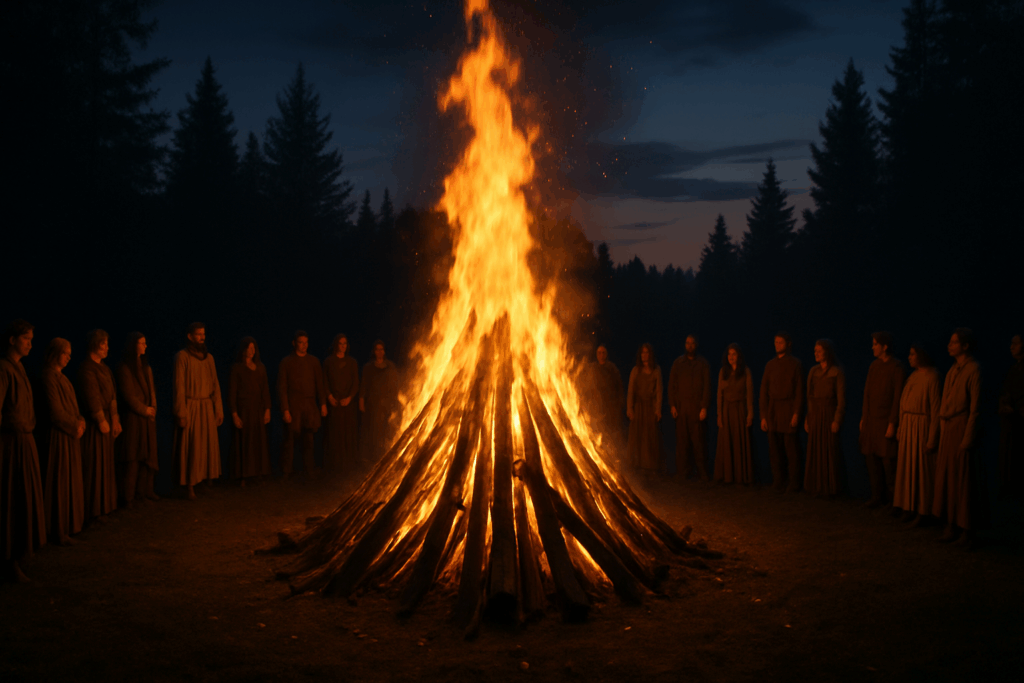
Traditionally, the burning of the Yule Log was a communal act, the centerpiece of the Feast of Midwinter Spirits that often preceded it. Families and neighbors would gather around the fire, sharing stories, songs, and food as sparks rose like stars into the dark. The fire was believed to drive away malevolent spirits, cleanse misfortune, and invite good fortune for the coming year. Ashes from the Yule Log were scattered upon fields for fertility or kept in the home as protective talismans — a fragment of the solstice’s sacred flame to guard the house from lightning and harm.
You may wish to adopt this custom by keeping a small piece of ash or charcoal from your Yule fire (or candle). Wrap it in cloth or place it in a charm bag, saying:
“From fire’s heart, this gift I keep,
To guard my home while I rest and sleep.”
Store it near your hearth or doorway, where it will serve as a guardian until next Yule, when you may return it to the flames in renewal.
The Fires of the Yule Log carry profound symbolism of transformation. The log represents the old year — its trials, lessons, and memories — while the flame represents spirit’s purification and renewal. As the wood burns, it releases its energy back into the world as heat and light, reminding us that even in endings, there is giving. In this act of combustion, we witness the mystery of rebirth: nothing truly dies; all is transmuted. The fire consumes, yet what it releases is life itself — warmth, light, and nourishment to the soul.
In your meditation tonight, you might reflect upon what you wish to offer to the fire. What burdens will you surrender to the flames, and what blessings will you carry forward? Write these upon small slips of paper — one for release, one for renewal — and feed them gently to the fire or pass them through candle flame. Watch the smoke rise like prayers ascending to the sun, bearing your intentions into the infinite night.
This is also a time to speak gratitude aloud, for gratitude is the truest offering of all. Thank the earth for its endurance, the ancestors for their watchfulness, the spirits of fire for their gift of warmth. A simple prayer might be:
“To fire, I give thanks for light.
To earth, for strength.
To air, for breath.
To water, for grace.
May all within me and around me
Burn pure as this flame,
Renewed with the rising of the sun.”
In this prayer, you become part of the eternal exchange — giving thanks for the elements that sustain you, and promising to honor them in the year to come.
In many pagan circles, the Yule Log ceremony concludes with blessing those gathered. Each person touches the flame’s light — perhaps with a taper or candle — and carries it to another, symbolizing the spread of love and endurance. In solitary practice, this can be done symbolically by lighting a second candle from the first and placing it in another room, saying: “As this flame spreads, so may peace and warmth spread through all hearts.” This act extends the ritual beyond your hearth to the wider world, weaving your personal flame into the collective fire of humanity.
Spiritually, Fires of the Yule Log is a rite of endurance and love — a declaration that warmth will prevail through winter, that community will hold fast, and that the light we tend within will always outlast the longest night. The burning of the log unites the personal and cosmic: our hearths mirroring the sun’s hidden power, our fires joining the great fire of life. To tend flame in the darkest season is to align oneself with the eternal rhythm of rebirth.
When the flames finally die down, and only embers glow, sit quietly for a moment. The ashes shimmer faintly, as though holding the last breath of the sun. Whisper a final blessing:
“Flame of Yule, burn in my heart,
Through every dark, through every part.
Until your child, the dawn, is born,
Keep me safe through night and storm.”
Then, let the fire rest. The ashes that remain are sacred; their gray dust is not loss, but promise — the bones of fire waiting to be reborn. As tomorrow dawns, so too will the sun, and the light we have kept will find its reflection in the sky.
On this night before the solstice, the Fires of the Yule Log remind us that every spark matters, every act of love sustains the world, and every ending feeds the seed of renewal. Through flame, we remember the oldest truth of all — that the light never truly dies; it only changes form, waiting for the song of dawn.