December 8 – Echoes of the Sun Wheel

As winter deepens and the days grow shorter still, the memory of the sun becomes a thread woven through our dreams. The world seems caught in stillness, yet beneath that stillness, a wheel continues to turn — vast, eternal, unbroken. On December 8, we honor Echoes of the Sun Wheel, a day devoted to remembering the endless turning of the cosmic year, the ancient cycles that bind light and darkness, birth and decay, gods and mortals in the dance of time. This is a meditation on Yule’s origins — the ancient festivals of renewal that predate history itself, when humankind first looked to the heavens and saw meaning in the motion of the sun.
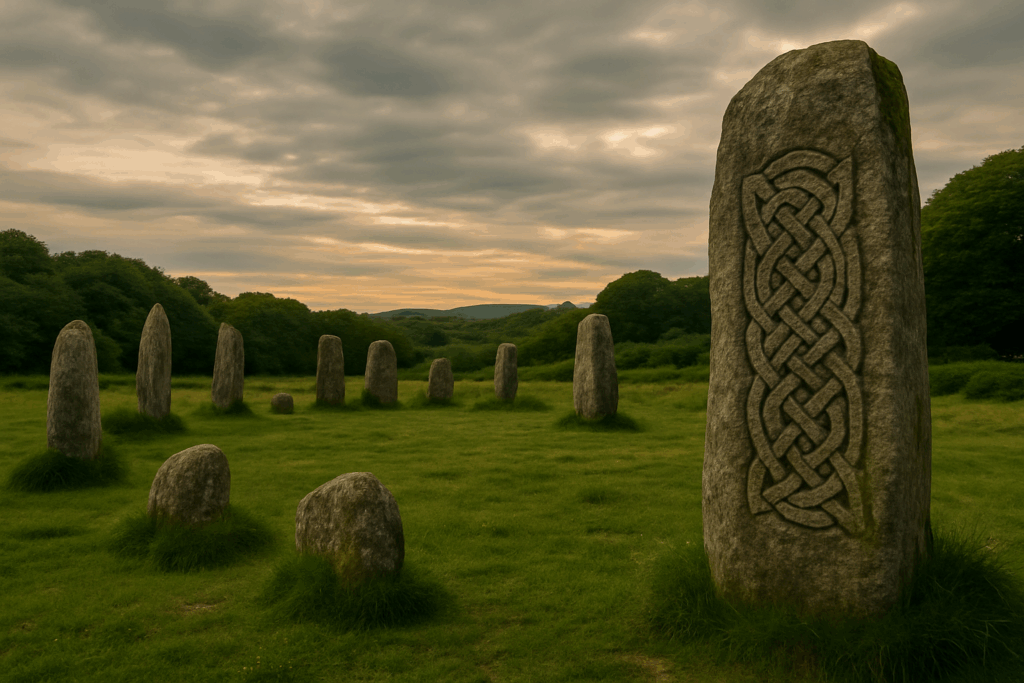
Before calendars and clocks, the ancestors knew the year by the sun’s path. They watched its rising and setting, its arc across the sky growing shallower as winter approached, and deeper again as spring’s promise neared. The great stone circles — Stonehenge, Newgrange, Callanish, and countless lesser-known rings — are echoes of that knowledge. They are temples of alignment, built to honor the sun’s return, the turning of the great celestial wheel. Every solstice, every equinox, every fire lit in honor of the seasons was an act of remembering: that we, too, move in cycles. Life’s changes are not linear, but circular — a spiral dance of return and transformation.
The Sun Wheel itself is one of paganism’s oldest symbols. Long before it became the modern “wheel of the year,” it appeared as the solar cross — a circle divided into four equal parts, marking the solstices and equinoxes. It represented the eternal nature of life, the balance of light and dark, and the harmony between heaven and earth. Among the Norse, the sun wheel was called Sólhjól, and it was burned as a fiery disk during Yule, rolled down hills to symbolize the returning strength of the sun. Among the Celts, it was the sacred wheel of Taranis, god of thunder and cosmic order. In all traditions, it was a sign of renewal and divine rhythm — the promise that after the longest night, dawn will come again.
To meditate upon the Echoes of the Sun Wheel is to remember our place in that cosmic rhythm. The modern world moves in straight lines — deadlines, schedules, clocks — but the spirit knows the language of circles. The seasons are not steps forward but turns upon an ancient wheel, and each turn brings both an ending and a beginning. When we forget this, we feel trapped by time; when we remember it, we are liberated. Every winter holds its spring, every death its rebirth, every night its dawn. This is the gospel of the sun wheel — the eternal return, the sacred balance that governs all things.
In this season of darkness, the wheel’s echo calls us inward to reflect on the cycles within our own lives. Where are we in our personal turning? Are we in a time of waning, releasing, and stillness — or in the first stirrings of renewal? The outer wheel mirrors the inner. Just as the sun seems to pause before rebirth at the solstice, so too must we rest before rising. To resist that stillness is to resist nature’s wisdom. The dark teaches us to listen, to trust the unseen, to believe that the light will return even when all appears lost.
To honor this day, one might create a Sun Wheel of their own. Gather twigs, vines, or straw and weave them into a circle, binding them with red and gold thread — colors of fire and vitality. If crafting is not possible, draw or visualize the symbol instead. As you work, think of the four cardinal points: north for endurance, east for renewal, south for vitality, west for release. Speak a simple charm as you turn the circle in your hands:
“Wheel of the sun, turning still,
Through shadow and flame, by fate and will.
I honor your path, eternal and bright,
Guiding the world through day and night.”
When finished, place the wheel upon your altar or hang it above your doorway as a talisman of balance and protection. It is said that the sun wheel not only blesses the home but also keeps the energy of the household attuned to the cycles of nature, ensuring peace through the changing seasons.
This day is also one of remembrance. The echo of the sun wheel is carried in our myths and rituals — the story of the dying and reborn god, the cycle of the Goddess through her many faces. In Celtic lore, the Holly King reigns through the dark half of the year until the Oak King is reborn at Yule, a reflection of the sun’s descent and resurgence. In Norse tradition, Baldr’s death and return mirror the light’s ebb and flow. Even far older solar deities — Ra, Mithras, Sol Invictus — all bear the same truth: light must die to be renewed. These myths are not only stories of the heavens but stories of our souls.
To live in harmony with the sun wheel is to accept change as sacred. The wheel turns regardless of our will — seasons pass, people come and go, joy and sorrow weave their eternal dance. But in that movement lies peace. Pagan wisdom teaches us to move with the wheel, not against it, to find rhythm within change. When we honor the cycle, we cease clinging to what must end and open ourselves to what must begin. That is the spiritual lesson of December’s dark — to trust the wheel’s turning even when the sun’s light seems lost.
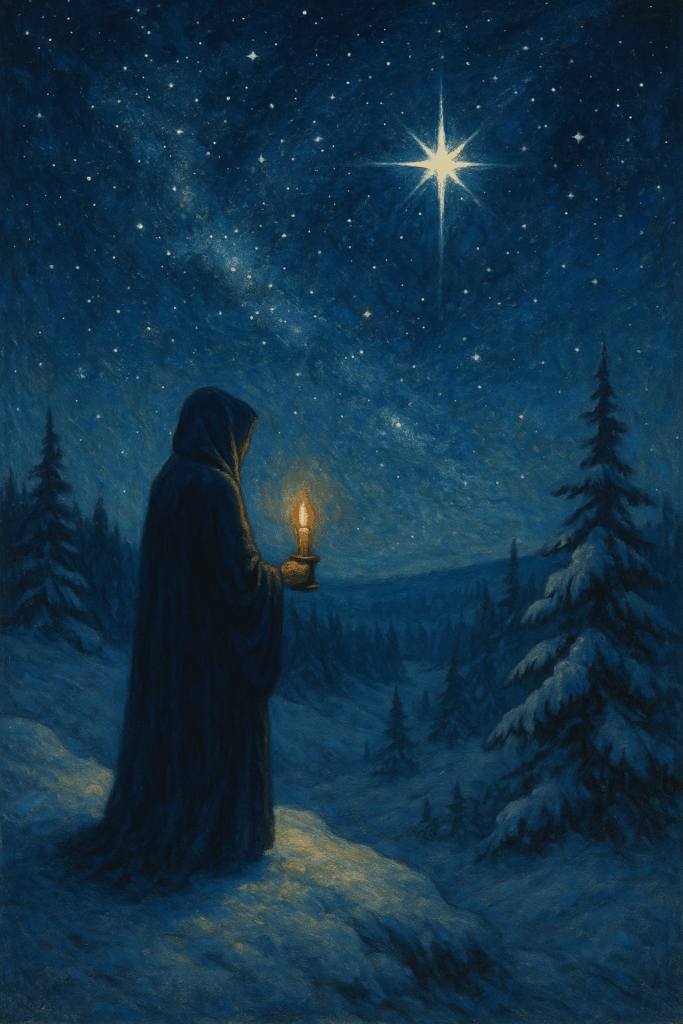
You might mark this day with a Fire Meditation. Light a single candle and gaze into its flame. Imagine the candle as the sun at its lowest point, burning quietly but steadily through the long night. Feel your own energy aligning with that same rhythm — low, deep, and constant. Whisper softly:
“Though darkness reigns, the fire remains.
The wheel turns, and I endure.”
As you meditate, visualize the sun’s path returning, the light gathering strength once more. You are participating in that movement, your own inner fire awakening with the season’s slow ascent. This ritual helps align your body, spirit, and intention with the cosmic dance of renewal.
If you wish to deepen your practice, draw the Wheel of the Year on paper, marking the eight sabbats — Yule, Imbolc, Ostara, Beltane, Litha, Lammas, Mabon, and Samhain. Reflect on where you stand upon this wheel. What lessons from the past year have you carried forward? What do you wish to release before Yule’s rebirth? This act transforms reflection into sacred participation — you are no longer a mere observer of the wheel; you are part of its living movement.
The Echoes of the Sun Wheel remind us that Yule is not simply a celebration of light returning, but of time itself — the eternal rhythm that sustains all existence. Even now, as winter holds sway, the earth tilts slowly toward renewal. The sun, though weak, climbs fractionally higher each day. In that motion lies hope — subtle, invisible, but unstoppable. The universe itself breathes in this rhythm: expansion, contraction, expansion again. So too do we, with every breath, every heartbeat, every birth and death we witness.
On this day, take a moment to step outside at dawn or dusk and face the horizon. Feel the movement of the heavens — the slow spin of the earth beneath your feet, the patient dance of the stars above. Whisper your gratitude to the sun for its journey, for the warmth and growth it will soon bring again. The echo of the sun wheel is the echo of your own spirit — always turning, always renewing, always becoming.
And as the night deepens, remember: the wheel does not fear the dark, for it knows that every descent is the beginning of a rise. The light is never truly gone; it merely turns inward for a time, gathering strength to shine once more. The echo resounds through every season, through every soul — an unending song of return.