🕯️ February 3 – The Well and the Forge: Water and Fire Magic for Purification and Creation

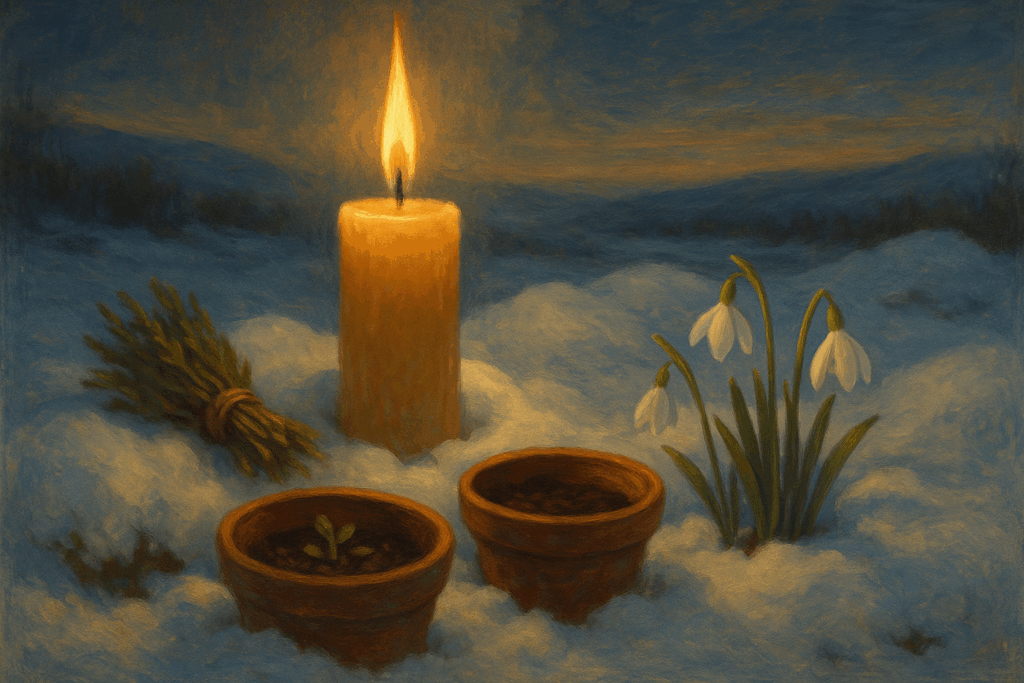
As the wheel of the year turns through the early days of February, the sacred fires of Imbolc continue to glow. The light kindled on the first and second days deepens now into understanding. The themes of purification and creation rise hand in hand — the cleansing waters that wash away what has been, and the sacred flame that shapes what is to come. February 3rd, known as The Well and the Forge, unites two elemental forces that seem opposite but are, in truth, inseparable partners in the great dance of transformation.
Fire and water — the twin powers of Brigid, goddess of light, forge, and healing springs — remind us that creation begins not in domination of one over the other, but in balance. The forge, where heat and strength unite to shape the world, depends on water’s coolness to temper the flame’s intensity. Likewise, the well, calm and deep, mirrors the sky’s fire and holds its light upon the surface. These elements are not rivals; they are mirrors, each teaching the art of transformation from its own essence. Today’s observance invites us to work with both — to purify the inner well of the spirit and to tend the forge of inspiration and will.
In Celtic tradition, Brigid’s sacred wells were places of deep reverence. Pilgrims visited them to seek healing, to pray, and to commune with the goddess whose spirit flowed through the waters. Offerings were left at the edges — coins, ribbons, flowers — tokens of gratitude and devotion. The wells were seen as portals between worlds, where the unseen met the seen, where prayers entered the living current of the earth. Water, in this sacred context, was more than mere sustenance; it was the vessel of blessing and renewal. To touch Brigid’s well was to touch the pulse of life itself.
Even today, the act of approaching water can be profoundly spiritual. A simple ritual might begin with filling a bowl with clean water, perhaps infused with herbs such as rosemary or mint for clarity. Gaze into the surface and see not only your reflection, but your essence beneath it — the part of you that is calm, adaptable, and eternal. Whisper your intentions into the water: what do you wish to cleanse, to release, or to renew? The well does not judge. It receives all things and transforms them quietly, returning peace where there was tension, clarity where there was confusion. Water teaches surrender — the wisdom of letting go and allowing flow.
Yet purification alone is not enough. To cleanse without creating is to empty the vessel and never refill it. And so we turn from the well to the forge — the place of making, of purpose, of divine fire. If the well represents reflection and renewal, the forge symbolizes will and manifestation. It is the crucible in which inspiration, once purified, is given form. Fire burns away impurities but also awakens the creative impulse that shapes raw material into art, vision, or action.
At the forge, we meet another aspect of Brigid — the Smith, patroness of craftsmen, makers, and those who work with their hands to shape reality. The forge is both literal and symbolic. It may be a blacksmith’s anvil, but it may also be a desk, a canvas, a kitchen, or any space where creation occurs. Each of us holds a forge within — a place where the heat of our passion meets the tools of our intention. To stand before this inner forge is to ask, What am I creating? What am I shaping with my energy, my words, my love, my life?
To honor this day, one might perform a ritual of balance between fire and water. Begin by lighting a candle — the sacred flame of Brigid. Place beside it a bowl of blessed water. Allow the two elements to speak to one another in silence, the light reflecting softly in the liquid’s depths. Dip your fingers into the water, then hold them briefly over the flame’s warmth, feeling the interplay of cool and heat. This is the heart of The Well and the Forge — to be tempered by both. One gives clarity; the other, strength. Together, they refine the soul.
This day’s wisdom lies also in its metaphor for human transformation. In every life, there are times of immersion and times of ignition. There are moments when we must submerge into the depths of reflection, washing away what no longer serves, and moments when we must rise to the anvil, ready to shape our destiny with courage and creativity. To live fully is to learn when to cool and when to burn — when to rest in the flow and when to strike the spark.
Many practitioners associate the Well and Forge with the union of intuition and action. The well is the intuitive self, receptive and deep, drawing from unseen sources. The forge is the active self, deliberate and focused, bringing vision into tangible form. When the two work in harmony, our lives move with both grace and direction. Too much water, and the flame sputters — ideas remain unmanifested, dreams unfulfilled. Too much fire, and the well dries — passion becomes burnout, action loses meaning. But in balance, there is alchemy: inspired action rooted in wisdom, and rest infused with purpose.
To embody this balance, one might carry two symbols today — a small vial of water and a piece of metal or stone, each blessed in Brigid’s name. The water reminds you to remain fluid and compassionate; the metal or stone, to remain grounded and strong. Together they form a talisman of the day’s power — a reminder that creation begins with inner equilibrium.
There is also a healing aspect to this observance. Brigid’s wells were, and still are, places of physical and spiritual restoration. Visitors wash their hands, faces, or hearts, praying for renewal. In the forge’s fire, likewise, there is transformation — the burning away of illness, stagnation, or sorrow. Some traditions blend these two energies by warming water with candle flame, using it for anointing or scrying. The warmth carries both cleansing and empowerment — fire’s vigor softened by water’s compassion.
In a broader spiritual sense, The Well and the Forge symbolize the twin creative principles that shape the universe itself: dissolution and formation, rest and action, yielding and striving. The cosmos breathes in cycles of contraction and expansion, destruction and renewal. Every creation story holds these forces in its heart — the waters of chaos and the divine spark that gives them order. To participate in this day’s ritual is to align with that cosmic rhythm, to recognize oneself as both creator and creation, both well and forge.
As twilight descends on February 3rd, the world seems to shimmer with balance. The snow melts slightly beneath the soft light; streams run with quiet music. Smoke from hearths curls skyward, a testament to both fire’s warmth and water’s patience. In this harmony of opposites, we find serenity. The Well and the Forge are not opposing altars, but two ends of the same sacred path. One begins in the depths and rises to the light; the other burns brightly, only to be cooled again in the healing waters. Life, too, flows this way — a rhythm of purification and creation, always circling, always renewing.
When you finish your evening rites, take a few moments to reflect: What must you release into the well, and what will you forge from what remains? Speak your gratitude aloud to the elements. Thank the water for its forgiveness and the fire for its courage. Then, as your candle flickers low, let the light reflect once more upon the water’s surface — the eternal dialogue between calm and flame, between yielding and shaping. This is Brigid’s mystery: that the path to creation always begins with cleansing, and that from the quiet depths of renewal, the forge of life is forever reborn.