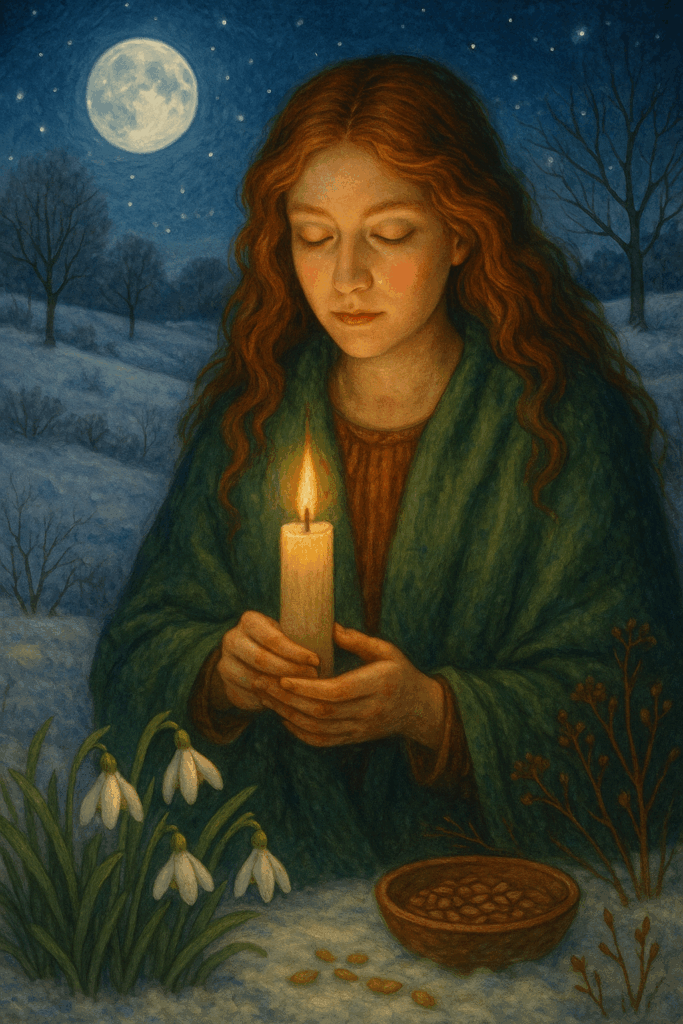
🕯️ February 16 – Candles in the Window: Inviting Light and Guidance into the Home

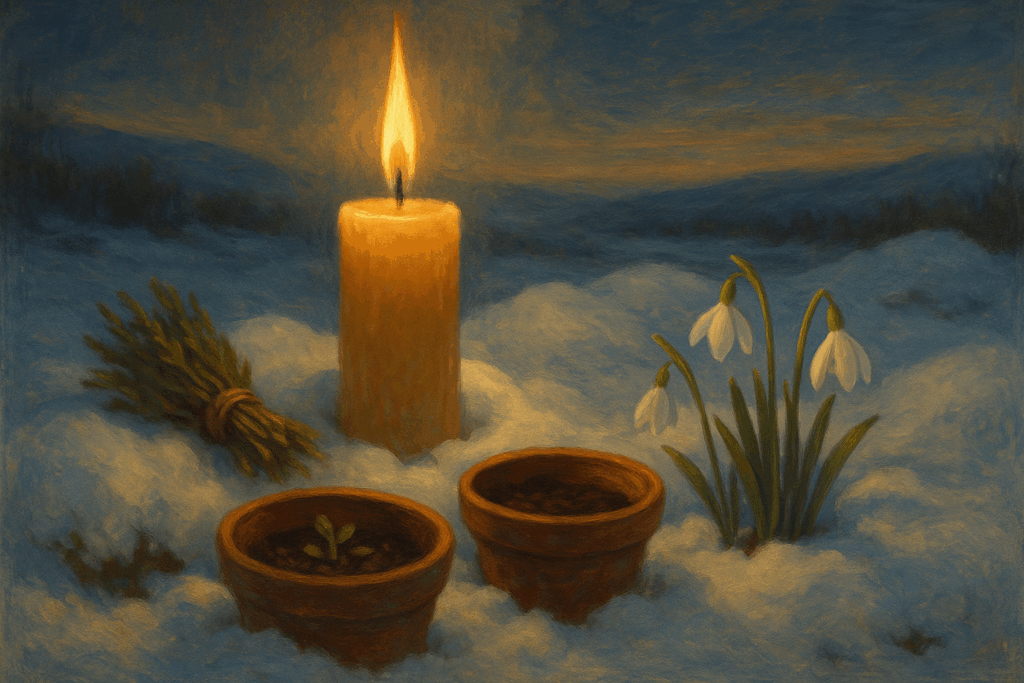
By February 16th, the spirit of Imbolc has become both inward and outward — a time when the fires kindled in devotion now begin to radiate as beacons of welcome and guidance. The air still carries the chill of winter, yet the days are unmistakably lengthening, and the low sun glows like a promise upon the horizon. This is the day of Candles in the Window, a simple but deeply meaningful rite of light — a gesture that has endured across centuries as a symbol of hospitality, hope, and divine guidance.
In the old Celtic lands, to place a candle in the window on a winter’s night was both a spiritual and communal act. It signified a home that was open to blessing, a hearth that welcomed travelers, and a soul that sought the presence of the divine. Under Brigid’s guardianship, this light became more than a physical signal — it was a sacred invitation, a prayer in flame form. Each flicker whispered: Here there is warmth, here there is peace, here there is love.
On February 16th, as part of the great turning from darkness toward spring, we rekindle this tradition — placing our candles not merely as decoration, but as vessels of intention. These flames become sentinels of spirit, guiding our hearts, our households, and all who journey through life’s uncertain paths.
Brigid, Keeper of the Flame
Brigid, as both goddess and saint, is forever linked to the sacred flame. In her ancient temple at Kildare, her priestesses — later Christian nuns — kept an eternal fire burning in her honor. That flame was said to give protection to all of Ireland and light the way for those seeking her wisdom. Even today, many still tend a candle on her feast days, continuing the lineage of her light.
The candle in the window is an extension of this holy fire — a fragment of Brigid’s eternal flame placed in our homes. It represents faith that the light never truly dies, even when unseen. It is also a declaration of presence: “My home and heart stand as part of the living light.”
In a deeper sense, it symbolizes guidance — the inner lamp that leads us through uncertainty. Just as travelers once looked for distant window flames to find safe haven on a stormy night, our souls look for signs of light within us when life grows dark. To light a candle in your window today is to remind yourself and others that guidance is always near, that hope can be kindled anew at any moment.
The Ritual of the Window Candle
To perform the Candles in the Window rite, begin as dusk falls. Clear your window space, removing clutter and dust, as an act of symbolic clearing. As you prepare, imagine you are not just cleaning glass, but opening a portal between worlds — between the hearth of your home and the wider universe of spirit and humanity.
When the space feels ready, choose a candle — ideally white, gold, or soft amber, colors that carry warmth and purity. Place it on the windowsill, facing outward. You may set it upon a small cloth or tray to elevate it, and beside it, place a small bowl of water or a few fresh greens to represent life’s renewal.
Light the candle with intention, saying words such as:
“Flame of Brigid, flame of light,
Shine within and through this night.
Guide the lost and bless the near,
Bring warmth and wisdom to all who draw near.”
As the candle burns, watch the way the light plays upon the glass. It reflects outward and inward at once — a perfect symbol of reciprocity between inner and outer worlds. The light that blesses others also blesses you. The guidance you offer to the unseen traveler also illuminates your own path.
Allow the candle to burn for a time — even just an hour — as an offering of light to the world. If you live in a shared dwelling or cannot leave a candle unattended, a safe LED candle or a small electric light can serve the same symbolic purpose; intention carries the energy, not the medium.
The Candle as Beacon of Welcome
In traditional Celtic and Irish households, a candle in the window was also a gesture of hospitality — a light that said, “This house is a place of safety.” It was a sign of open-heartedness, a silent assurance that strangers would find welcome and kinship within.
In honoring this tradition today, we can also reflect on what it means to be a source of welcome — not only to guests at our door, but to the people and opportunities that come into our lives.
Ask yourself: Is my heart open to receiving new light? Do I create warmth for others through kindness and presence?
Each of us has the power to be a window candle for another — to offer comfort, clarity, or simple human care in dark times. The smallest flame can be enough to guide someone home.
If you wish to extend this energy outward, write a short note or blessing for the world and place it beside your candle. You might write:
“May this light guide those who wander,
May it bring peace to troubled hearts,
May it kindle courage in the weary,
And may it remind all souls — they are never alone.”
Guidance and the Inner Light
The Candles in the Window also reflect the light of guidance — that mysterious inner knowing that often glimmers softly rather than blazing with certainty. Brigid’s flame does not blind; it illuminates gently, allowing us to take one step at a time through life’s unfolding path.
Spend a few quiet moments in meditation before your window candle. Gaze into the flame and ask, What guidance am I seeking at this moment?
Do not rush for answers; simply allow the light to move through you. Perhaps it will speak through an image, a word, a sense of direction, or a feeling of peace. The candle’s steady burn reminds you that clarity often arrives not in lightning bolts, but in quiet consistency — the same way dawn gradually reveals the shape of the land.
When you are finished, whisper:
“Brigid, keeper of flame and wisdom,
Guide my steps with light unseen.
May I walk with faith through shadow,
And find the path made clear by love.”
The Home as Lighthouse
To place candles in the window is to transform the home into a lighthouse of the spirit. It reminds us that spiritual practice need not be hidden in sacred groves or temples — it can live in the simplicity of domestic life. Every home can be a sanctuary, every window a beacon of grace.
Even when no one sees your light from the outside, the act of lighting it still ripples through the unseen realms. The flame’s vibration reaches beyond the physical — uplifting energy, dispelling heaviness, calling blessings to your dwelling and to those connected to you.
In this way, the ritual becomes both personal and collective: your light joins countless others across time, a network of tiny suns burning against the long night. Together, they form the great constellation of humanity’s faith in renewal.
Reflection and Closing
When the time feels right, return to your window and extinguish the candle with care, saying softly:
“The flame rests, but its light remains.
May its glow linger in my home and heart.”
Take a moment to notice how the room feels — softer, quieter, subtly blessed. The act may seem small, but the shift is real. You have invoked illumination and guidance not only for yourself but for the wider web of life.
As you prepare for rest, remember that every night the world darkens only to reveal the stars. Your candle, though extinguished, has joined their company. Its flame lives on — in you, in Brigid’s eternal fire, and in the countless acts of kindness and clarity it will inspire.
The lesson of Candles in the Window is both ancient and immediate:
To be light for others, we must tend our own flame.
To guide others home, we must first dwell in peace.
And to welcome blessing, we must open both heart and hearth.
So tonight, let your window glow — a symbol of warmth amid cold, faith amid uncertainty, and the enduring truth that even the smallest flame can keep the darkness at bay.