
🕯️ February 12 – The Smith’s Anvil: Transformation Through Fire and Effort — Crafting One’s Path

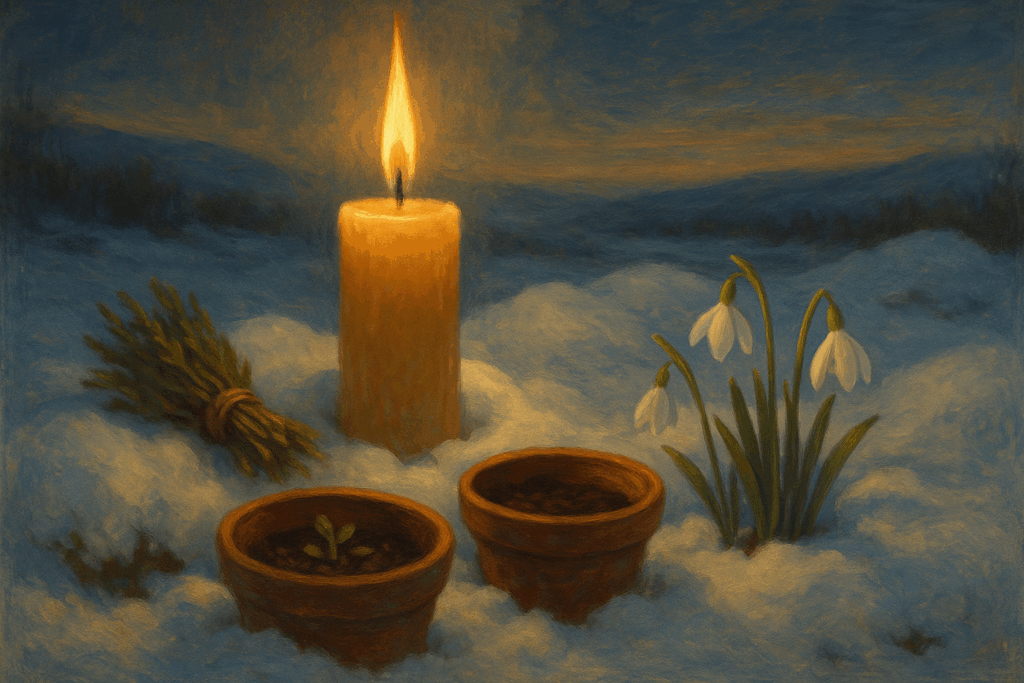
As the days of February continue their slow brightening, the sacred fire of Imbolc deepens from gentle inspiration into the heat of transformation. By February 12th, we reach the day known as The Smith’s Anvil, a celebration of the sacred labor of creation — the meeting point of fire, will, and craftsmanship. This is Brigid’s forge, where raw intention becomes purpose, where the soul’s metal is shaped by both flame and effort. It is a day to honor the process of becoming, to embrace the hammer and the heat that refines us, and to recognize that every act of crafting, whether of art, life, or self, is a holy practice.
In Celtic lore, Brigid was not only the goddess of poetry and healing but also of smithcraft, the master of the forge whose creative fire mirrors the primal power of the sun. The smith, in ancient understanding, was a sacred figure — one who worked with the elements of creation itself: earth (metal), air (bellows), fire (flame), and water (quenching). To forge metal was to participate in divine alchemy, to transform what was hidden within the bones of the Earth into tools of beauty, utility, and strength.
So too, the spiritual path calls us to the anvil — the place where we are shaped by our own experiences, trials, and aspirations. The Smith’s Anvil is not merely a symbol of craft but of transformation through effort. Every blow of the hammer refines; every spark that flies is a piece of the old self burning away.
The Forge of the Soul
The inner forge is both literal and symbolic. It is the space where your true self is tempered — where passion meets discipline, and where ideas, once fragile as molten metal, gain form through persistence. Brigid’s forge is the sacred heart of creation, the crucible where divine inspiration becomes tangible.
To stand before this inner anvil is to ask: What am I shaping? What material has life given me, and what do I wish to make of it? Perhaps it is your work, your relationships, your creative calling, or your spiritual path itself. Whatever form it takes, the anvil reminds you that creation requires contact — the meeting of opposites, the pressure of challenge, and the rhythm of perseverance.
The fire of transformation is not always gentle. It can be demanding, sometimes painful. But just as the metal cannot resist the flame and still become the tool it was meant to be, we too must surrender to the refining process that life offers. The Smith’s Anvil teaches courage — the bravery to stay within the fire long enough to be transformed by it.
The Sacred Craft of Effort
In ancient tradition, the smith was both artisan and magician. Every hammer strike was an invocation, every spark a prayer. To work with fire and metal was to shape destiny itself. The ritual of smithcraft was a living metaphor for the act of human becoming: heat, pressure, rhythm, and patience, followed by cooling and rest — the eternal cycle of effort and renewal.
To honor this spirit, one might create a symbolic forge ritual. You need not have a literal anvil or hammer; intention will suffice. Light a candle to represent the sacred flame. Place before it an object that symbolizes your current challenge or aspiration — a stone, a piece of metal, a tool, or even a written word describing your goal. Take a deep breath and say:
“I stand before the forge of life.
I offer what is raw and unshaped within me.
By fire and will, may it be refined.
By Brigid’s flame, may I craft my path with purpose.”
As you hold the object or gaze upon it, imagine it glowing with heat, becoming malleable in the fire of your will. See yourself working with it — not forcing, but guiding. Each imagined hammer strike represents an act of courage, an effort made in love, a choice toward integrity.
When you feel the work complete, visualize plunging the object into cool water, watching the steam rise as it hardens into something new — something stronger, clearer, truer. Whisper: “It is done. The work continues.” This small rite becomes a powerful act of alignment — a recognition that you are both the smith and the metal, the maker and the material.
Fire as Teacher
The forge’s fire is a teacher of paradox. It is both destructive and creative, consuming impurities while giving life to form. Spiritually, this duality reminds us that destruction is not always loss; it is often the clearing that precedes growth. The old identity must soften before a new one can take shape. The habits that once protected us may, under the flame of awareness, melt away to reveal the core of strength beneath.
To sit with this truth, spend a few moments gazing into the flame of your candle. See it not as something separate from you, but as the living reflection of your inner fire — your drive, your resilience, your purpose. Ask the flame: What must I release to be made new? Wait in silence. The answer may not come as words, but as a feeling — a warmth, a knowing, a quiet resolve.
Brigid’s fire is not meant to consume you but to awaken you. It is the creative fire that forges without destroying, that strengthens without hardening. It asks not for perfection but for participation — the willingness to keep shaping, to keep trying, to keep creating even when the outcome is uncertain.
The Rhythm of the Hammer
Listen, too, for the rhythm of the hammer — that steady cadence that mirrors the heartbeat of creation itself. Every pulse, every breath, every step upon the earth is an echo of that rhythm. The smith’s work is sacred because it is done in time with the cosmos — a dance of will and patience.
In your daily life, this rhythm appears in every repeated act: the keystrokes of a writer, the beats of a drum, the chopping of wood, the washing of dishes. Each can become an echo of the forge when done with awareness. The hammer need not be literal; it is any focused act of creation carried out with love.
To honor this, choose one ordinary task today — something repetitive or routine — and perform it as a sacred action. Breathe in rhythm, move with mindfulness, and imagine each motion as a strike of the hammer shaping your destiny. By doing so, you infuse the mundane with meaning and transform effort into devotion.
The Maker’s Blessing
At the end of your ritual or day’s work, take a moment to honor the maker within you. Place your hand over your heart and say:
“I am the smith of my spirit.
Through fire and effort, I am shaped.
Through patience and purpose, I create.
May my hands, my words, and my will
Craft beauty and truth in all I do.”
Feel the pulse beneath your palm — that steady rhythm is your anvil, the heartbeat upon which your life is forged. Each beat a spark, each breath a stroke of the hammer, each day an opportunity to shape something lasting and luminous.
The Lesson of the Anvil
The Smith’s Anvil reminds us that transformation is an art of cooperation with the forces that shape us. We do not control the fire; we work with it. We do not force the metal; we listen to its needs. The process is slow, sometimes arduous, but always sacred.
Brigid, standing at the forge, smiles upon all who persevere — the craftsman who shapes metal, the writer who refines words, the healer who restores balance, the soul who endures difficulty with grace. Her gift is not only inspiration but resilience — the strength to keep creating even amid uncertainty.
As night falls, let your candle burn a little longer. Watch how its flame bends, flares, and steadies again — much like the rhythm of a life in transformation. The forge is never silent; even when the work pauses, the embers glow, ready to awaken again at your touch.
So too does your inner anvil await your hand — ready to help you shape the path ahead, strong and luminous beneath Brigid’s eternal fire. Remember: creation is not the act of perfection, but of persistence. The world is remade every time you lift the hammer of your will and strike toward your highest self.