🕯️ February 9 – Milk and Honey Offerings: Traditional Food Magic to Honor the Earth’s Renewal

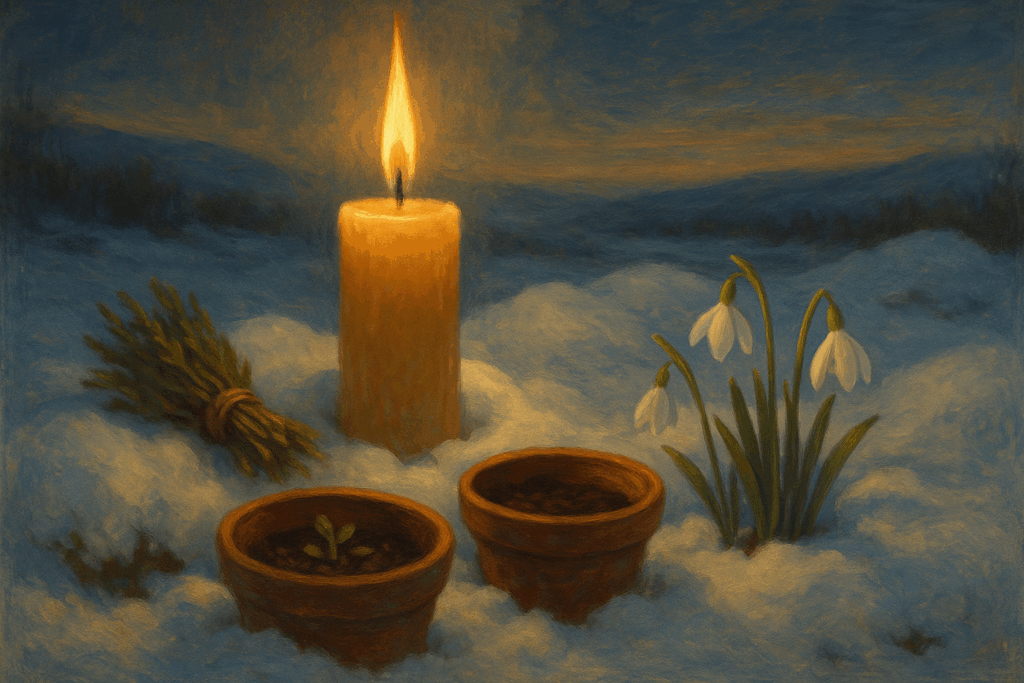
By February 9th, the sacred season of Imbolc is deep in motion — a time when light continues to lengthen, and life beneath the soil stirs with greater confidence. The Earth, though still cold, begins to breathe more freely, her frozen mantle loosening under the whisper of the returning sun. This day, Milk and Honey Offerings, is devoted to the sweet exchange between nourishment and gratitude, between what the Earth gives and what we give back. It is a day for food magic, a gentle and tangible form of devotion that transforms the simple act of sustenance into a living prayer of renewal.
The pairing of milk and honey is ancient and symbolic across many cultures. Together, they represent purity and abundance, simplicity and sweetness — the white nourishment of life and the golden essence of joy. In Celtic lands, these gifts were sacred to Brigid, patroness of fertility, healing, and inspiration. Milk, drawn from the ewe or cow, symbolized the first flow of spring’s bounty; honey, the distillation of sunlight and labor, evoked the warmth of the divine. To combine the two was to honor both Earth and sky — the nurturing ground and the radiant heavens — and to offer gratitude for their eternal union that sustains all life.
The Sacred Nourishment of Milk
In the rhythm of the pastoral year, the lambing season marked the return of fresh milk, a source of nourishment after the lean months of winter. Milk was life itself, and thus it became a sacred substance — poured upon the ground in libation, sprinkled at the hearth, or shared among family as a blessing. Spiritually, milk carries the vibration of purity, renewal, and maternal care. It is the first food of all mammals, the substance through which life continues.
In honoring milk today, we honor both the giving and receiving of care. A ritual of milk blessing can be simple yet profound: pour a small amount into a bowl, hold it to your heart, and whisper your gratitude — not only for the milk itself but for all sources of nourishment in your life. Say, “For all that feeds me, seen and unseen, I give thanks.” Then, with intention, pour a portion outside onto the earth or at the roots of a tree, offering it back to the Mother who provides.
In this exchange, you participate in the ancient cycle of reciprocity — the understanding that to receive is to give, and to give is to keep the balance of life in motion. The Earth does not demand grandeur; she responds to sincerity. Even a few drops of milk, poured with reverence, are enough to awaken the current of blessing.
The Golden Magic of Honey
Where milk represents sustenance, honey represents sweetness — the reward of patience, the alchemy of sunlight, time, and effort. The bees who craft it are sacred messengers of harmony, working tirelessly to transform the ephemeral into the eternal. To taste honey is to taste the memory of summer, stored safely through winter’s chill. It reminds us that sweetness can survive even the coldest seasons.
In magical and ritual traditions, honey has long been used as a symbol of attraction, prosperity, and divine favor. It draws to it what is good, amplifies intentions, and softens what is harsh. It is an offering beloved by spirits, gods, and ancestors alike. At Imbolc, honey offerings are made to honor Brigid and the awakening Earth, acknowledging both the sweetness already present in life and the sweetness yet to come.
To create a honey blessing, simply stir a small spoonful of honey into warm milk, watching as the two merge — sun and moon, light and nourishment, divine masculine and feminine, creative fire and soothing water. Sip it slowly as a sacred drink, letting it anoint your tongue and awaken your senses. As you do, envision your heart filling with golden warmth, your inner fires balanced by serenity. You might also use honey to anoint candles or doorways, drawing in abundance and joy for the months ahead.
The Union of Milk and Honey
When milk and honey are brought together, they create what the ancients saw as a sacrament of harmony. Each element complements the other: the richness of milk grounds the brightness of honey, while the honey’s sweetness enlivens the milk’s calm. Spiritually, they embody the union of Earth and Spirit — sustenance and joy, work and reward, effort and grace.
In Celtic myth, the lands blessed by gods and saints were often described as “flowing with milk and honey.” This was not simply a promise of material wealth, but a vision of divine balance — a world where nourishment and delight coexist, where the sacred feminine (milk) and sacred masculine (honey) work in harmony. To honor this union is to remember that life’s truest abundance arises when the practical and the mystical intertwine.
To create a Milk and Honey Offering Ritual, gather the following:
- A small bowl or cup of milk (cow, goat, or plant-based — the intention is what matters).
- A spoonful of honey.
- A candle to represent the living light of Brigid.
Light the candle and take a moment to breathe deeply. Mix the honey into the milk, stirring slowly clockwise. With each turn, whisper blessings — for health, for inspiration, for renewal, for harmony. When you are ready, hold the cup before your heart and say:
“Milk of Earth, honey of sun,
Together bless the work begun.
May sweetness and strength fill every part,
And warmth flow ever through this heart.”
Sip a little of the mixture as a personal blessing, then pour the rest outside, returning it to the soil as an offering of gratitude.
Food Magic and the Hearth
This day also celebrates the sacredness of food itself — the understanding that every meal, when prepared with mindfulness, becomes an act of magic. When you cook, bake, or even pour tea, you are engaging in alchemy: combining elements of earth, water, fire, and air to create nourishment that sustains life. The kitchen thus becomes a temple, and your hands, the priesthood of daily devotion.
In this sense, working with milk and honey today is not only symbolic but practical. Bake bread or cakes sweetened with honey and brush their tops with warm milk before baking. As you mix and knead, infuse the dough with intention — love, peace, creativity, or prosperity. As the bread rises, so do your prayers; as it bakes, your intentions solidify into form. When you share the food with others, you extend Brigid’s blessing outward — turning sustenance into sacrament.
Gratitude as the Heart of Offering
At its deepest level, the ritual of Milk and Honey Offerings is a meditation on gratitude — the act of seeing nourishment not as entitlement but as gift. In giving back to the Earth, we affirm our participation in her cycles. We remember that the light returning to the land is not separate from the light we kindle within ourselves. The sweetness we taste is the same sweetness we are called to share.
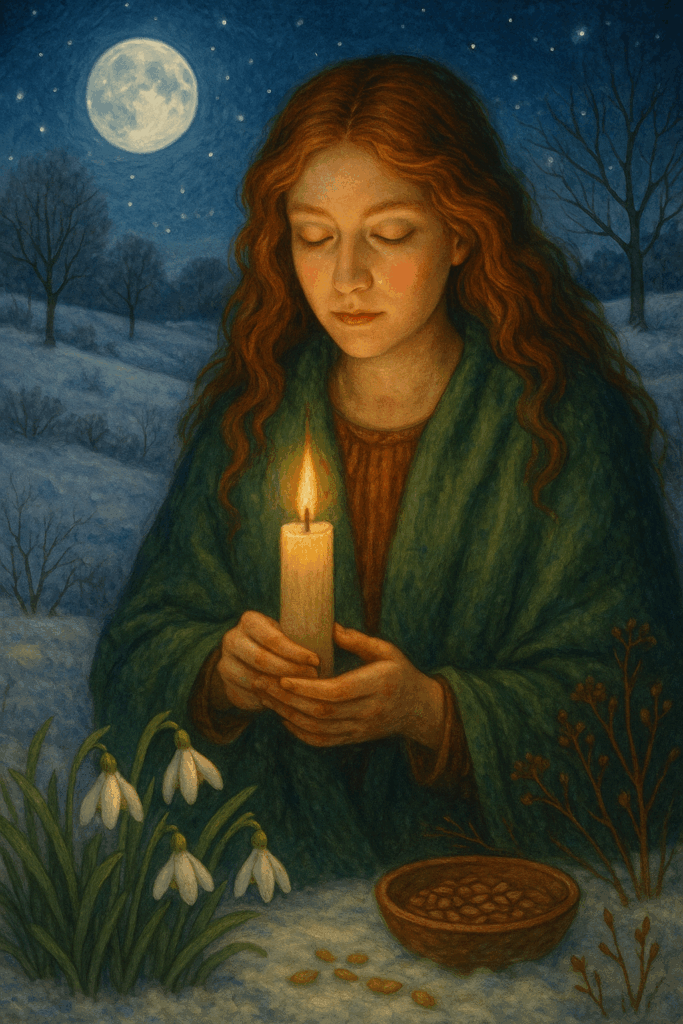
When the night falls on February 9th, take a final moment to sit by candlelight. Pour a small bit of milk and honey into a bowl and place it near your window or on your altar. Say:
“For the Mother who feeds all life,
For the flame that warms all hearts,
For the sweetness that endures all winters —
I give thanks.”
Let the offering rest overnight, then pour it into the earth the next morning. As you do, feel the connection between your body and the living world — a bond renewed through the simplest act of giving.
In honoring milk and honey, we honor both labor and love, both sustenance and spirit. We remember that abundance is not measured in quantity but in quality of care. And as Brigid’s season unfolds, we carry with us the wisdom of this day: that sweetness, when shared freely, multiplies; that nourishment, when offered with love, sanctifies all it touches.
The world, even in its wintry hush, is already humming with renewal. The milk flows, the bees dream of blossoms, and the light continues its slow ascent. All creation is awakening — and with it, the heart that gives and receives in equal grace.