🕯️ February 2 – Brigid’s Day of Light: Honoring the Goddess of Flame, Hearth, and Poetic Fire

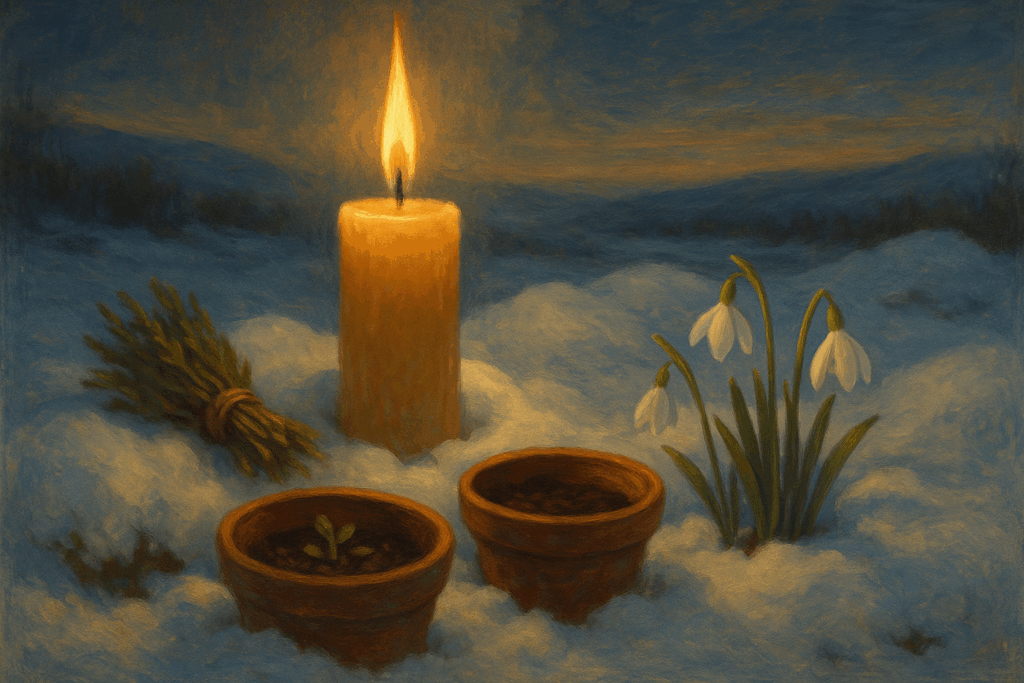
On the second day of February, the sacred light of Imbolc burns brighter — what was kindled yesterday as the Flame of the Maiden now grows into a steadier, living fire. February 2nd, often called Brigid’s Day of Light, is both a spiritual continuation and an elevation of that spark. It is a day to honor Brigid, the luminous goddess who bridges the worlds of hearth and heaven, of poetic inspiration and practical craft. On this day, we celebrate not only the goddess herself, but the light she carries — the wisdom, compassion, and artistry that she bestows upon all who tend her flame.
Brigid (also spelled Bríde, Bríg, or Brighid) is among the most beloved figures in Celtic tradition — a goddess of such enduring radiance that her worship transcended centuries and transformations. When Ireland shifted into Christianity, she was not diminished; rather, her essence flowed into Saint Brigid of Kildare, whose perpetual fire was tended by nineteen nuns in her honor. Both goddess and saint share the same attributes — flame-bearer, healer, poet, and protector of the hearth — revealing a timeless truth: that divine light cannot be confined by a single faith or form. Brigid’s day, then, is not merely a historical observance; it is an eternal recognition of the sacred feminine as the living heart of illumination.
The Day of Light begins in stillness, in the quiet moment before dawn. It is said that to rise early on February 2nd and greet the sunrise is to invite Brigid’s blessings into one’s life for the year ahead. As the first rays touch the land, frost sparkles like tiny flames, and the world feels suspended between ice and fire — a perfect reflection of Brigid’s dual nature. She is both warmth and clarity, passion and wisdom, the steady flame that transforms without consuming.
Traditionally, fires were lit in her honor, candles placed in windows to invite her presence, and hearths rekindled to symbolize her eternal watch over home and heart. Each small light was a prayer — for guidance, for healing, for the strength to create and sustain. Even in homes where fire was not possible, the lighting of a single candle was enough, for Brigid’s fire burns as much in the soul as it does in the world.
Brigid’s associations are many and profound. She is the goddess of poets, whose fiery inspiration flows like molten gold through words and song. She is the goddess of the forge, where raw material is shaped into purpose by heat, patience, and skill. She is the goddess of healing, whose warmth soothes the body and rekindles the spirit. And she is the keeper of the hearth, reminding us that the most sacred fires are those we tend daily — in our homes, our relationships, and our creative endeavors. Each of these faces of Brigid reveals a way of living with intention, beauty, and reverence for the sacred in all things.
To honor her today, one may prepare a simple altar of light and warmth — a white cloth, candles in shades of gold and red, perhaps a bowl of spring water or a sprig of early greenery. A loaf of bread or a small bowl of milk and honey may be offered to her, symbols of sustenance and sweetness. In ancient times, people would leave out food, drink, and woven Brigid’s crosses to receive her blessing overnight. It was believed that the goddess would walk the land on this night, visiting each home that called her name and bestowing protection upon the hearth.
In spiritual practice, the act of inviting Brigid is one of reverence and openness. One might say aloud:
“Lady of the Flame, keeper of light and forge, bless my home and heart this night. Inspire my words, warm my hands, and guide my craft. Let your fire burn within me — steady, bright, and kind.”
As you speak, visualize her presence — a figure cloaked in radiant fire, gentle yet fierce, moving through the still air with grace. Some see her as a maiden carrying a flame; others as a woman of gold and white, her hair the color of dawn. However she appears, she embodies the living energy of inspiration — that sacred fire which moves through all acts of creation.
The hearth itself is one of Brigid’s oldest symbols. In every culture, the hearth is both literal and spiritual — a center of warmth and nourishment, where food is prepared and stories are shared. To tend the hearth was once a holy act, a ritual of sustenance and gratitude. Though many of us no longer gather around open fires, we can still kindle the hearth within our homes — lighting candles at the dinner table, offering prayers of thanks while cooking, or creating a cozy space where peace and togetherness thrive. Brigid reminds us that holiness dwells in the everyday. To stir a pot with love, to craft something by hand, to speak truthfully and tenderly — these are modern acts of devotion.
As goddess of the forge, Brigid also teaches the sacredness of transformation through effort. The forge is a place of fire and patience — where raw ore becomes blade, and crude metal becomes art. In the same way, our lives are shaped by trials and triumphs, each experience refining us into something stronger and more purposeful. Brigid’s forge is not only the blacksmith’s anvil, but the inner crucible of the heart — where passion meets perseverance, and where courage is born. To honor her, one might meditate upon what is being “forged” in one’s own life. What challenges are shaping you? What fires are you walking through to become who you are meant to be? In Brigid’s light, even difficulty is holy, for it tempers the soul like steel.
Her poetic fire flows in the voice of the muse — the whisper of words, the rhythm of creation, the heartbeat of imagination. To write, paint, sing, dance, or simply speak with authenticity is to channel Brigid’s gift. On her day, creative acts become rituals. Take up a pen and let the words flow without judgment; let art become offering. Brigid does not demand perfection — only sincerity. Her flame seeks not the grand performance but the honest spark of expression that lives in every human being.
Even nature seems to echo her blessings on this day. The snow begins to soften, and the light grows stronger. Animals prepare for birth; seeds beneath the soil begin to quicken. The cycle of life reawakens under her touch. It is no coincidence that Candlemas, the Christian feast celebrated on this same day, honors light’s return — an echo of Brigid’s eternal fire, reinterpreted through another lens. Whether one honors goddess, saint, or simply the principle of divine light, the essence remains: illumination is returning to the world.
As the evening falls on February 2nd, let your space be filled with gentle warmth. Light a candle in every room if you can. Watch how the glow transforms the shadows, how the flame dances and breathes. This is the dance of Brigid — flickering, living, eternal. Speak softly to the fire, and listen for the whisper in return. For those who listen closely, the flame speaks in poetry, in intuition, in the quiet knowing that inspiration has arrived and that life, once again, begins to move toward the light.
Brigid’s Day of Light is not only a remembrance — it is a renewal of relationship. The goddess walks with us still, in every creative act, every moment of warmth we share, every spark of compassion that lights the human heart. To honor her is to remember that we, too, are bearers of flame. The divine fire dwells not in temples alone but in the simple acts of kindness, in the courage to create, and in the faith that light will always return.
So as you close this sacred day, hold the flame before you — not as a fragile thing to protect, but as a living presence that illuminates your path. Let Brigid’s fire burn within your words, your work, and your dreams. For she is the light that never fades, the hearth that never cools, and the inspiration that never ceases to rise.