🕯️ February 1 – Flame of the Maiden: Imbolc Rites and Blessings for Renewal and Inspiration

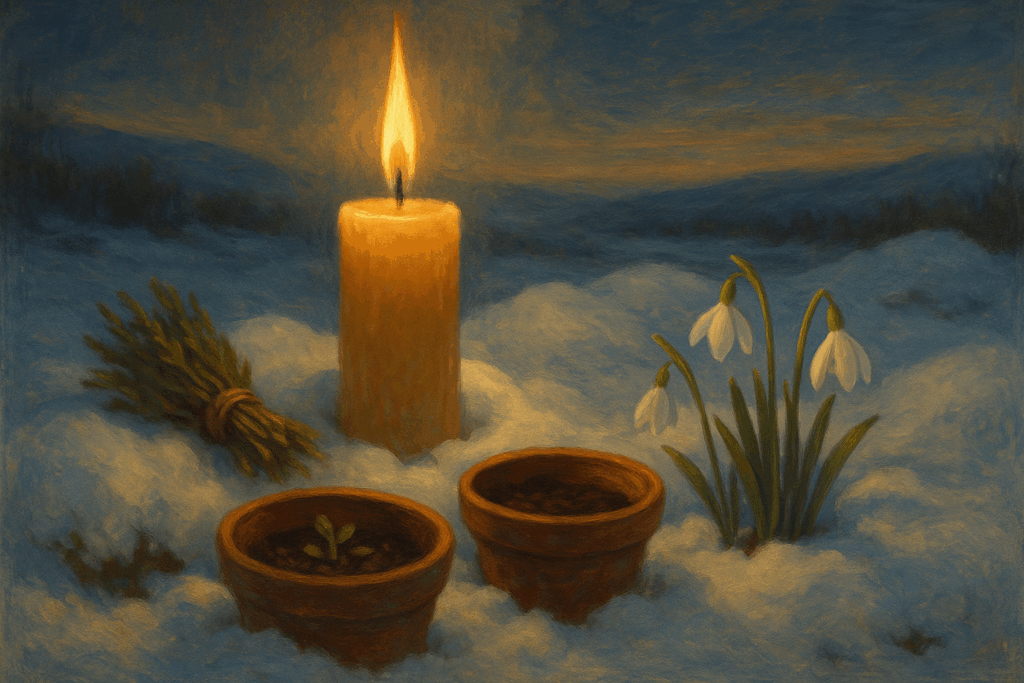
As winter lingers upon the land, February 1st marks a sacred turning of the wheel — the festival of Imbolc, a day of fire and promise, light and renewal. Though snow still clings to the ground and frost laces the eaves of the world, something subtle begins to stir beneath the surface. The days are lengthening, imperceptibly at first, but enough to whisper of spring’s eventual return. The air itself feels different — charged with potential, like the pause before a song. This is the Flame of the Maiden, the rekindling of life’s creative spark, and the moment when we honor Brigid, goddess of the hearth, the forge, and poetic fire.
Imbolc, sometimes translated as “in the belly,” speaks to what is hidden and gestating. It is the season of quickening, when seeds begin to awaken deep within the dark earth and animals prepare to give birth to the next generation. Symbolically, it is a time to awaken one’s own inner light, to nourish the tender sparks of inspiration that will grow into the works and dreams of the coming year. The Flame of the Maiden represents the rekindling of vitality after the long slumber of winter. It is the soul’s reawakening — the first gentle breath of creation stirring within the quiet heart.
In Celtic tradition, Imbolc was dedicated to Brigid, a radiant figure who stands at the threshold between goddess and saint. As a goddess, she governs fire in all its forms: the flame of the hearth that warms the home, the creative fire that kindles art and poetry, and the transformative fire of the forge that shapes raw metal into tools of purpose. As Saint Brigid, she carries these same blessings into Christian tradition — tending the perpetual flame at Kildare and continuing her guardianship over poets, smiths, and healers. Regardless of the form she takes, Brigid’s essence is one of illumination — a spark that kindles both mind and spirit, reminding us that every act of creation is an act of divine renewal.
The rites of Imbolc invite us to mirror nature’s quiet renewal within our own lives. Many traditions begin with purification — a symbolic sweeping away of old energy to make space for what is to come. Homes were once scrubbed and hearths rekindled, the ashes of the old fire replaced with a new flame. In modern practice, this can take many forms: lighting a single white candle to honor the rebirth of light, cleansing one’s altar, or writing down intentions for the coming months and burning them as offerings of transformation. The act is both literal and spiritual — by tending to our spaces and hearts, we prepare fertile ground for inspiration to take root.
Fire and water are the twin elements of Imbolc — opposites that together represent the alchemy of creation. Fire purifies and inspires, while water nourishes and renews. To honor both, practitioners might bless a bowl of water with candlelight, letting the flame reflect upon the surface as a symbol of harmony between energy and emotion, action and intuition. This sacred balance is at the core of the Maiden’s fire — the understanding that creation requires both passion and gentleness, both boldness and patience.
The Maiden aspect of the goddess represents new beginnings, innocence, and the courage to begin again. She emerges from the darkness not yet burdened by the heat of summer or the wisdom of autumn, but radiant in her potential. To invoke her presence is to honor our own capacity to start anew — to embrace the unformed ideas that lie dormant within us and breathe them into being. In ritual, one might anoint candles with herbs of inspiration such as rosemary, bay, and cinnamon, then light them while speaking affirmations of renewal: “From the spark within, I kindle my path anew. I am reborn in purpose, guided by light, and blessed by the flame of inspiration.”
Imbolc’s light is not yet the full blaze of spring — it is delicate, like the first snowdrop pushing through frost. It reminds us that growth begins in stillness, that creation is born from silence. The Flame of the Maiden teaches patience — the art of nurturing possibility without rushing its bloom. Just as a blacksmith must heat and shape the metal carefully, so too must we tend our own creative fires with attention and love. Too much haste, and the flame may burn out; too little, and it may fade. Balance is the truest offering to the goddess of the forge.
In ancient times, people crafted Brigid’s crosses from reeds or rushes, weaving them into the shape of a spiral or sunwheel. These crosses were hung above doors and hearths for protection and blessing throughout the year. Making one remains a powerful act of devotion — each strand woven with intention, each pattern a reflection of renewal. It is said that to create with sacred purpose is itself a prayer, a conversation between maker and spirit. In this way, every act of art, every poem written, every meal prepared with love becomes a ritual flame — a spark of divine energy made manifest through the hands.
The festival also honors community and generosity, for Brigid’s flame burns not for one but for all. Lighting candles for others — for friends, for ancestors, for the earth itself — expands the circle of light beyond the self. It transforms personal renewal into a collective blessing. As we ignite our candles, we send forth light to those in darkness, warmth to those in need, and hope to those seeking new beginnings. This shared illumination is the essence of Imbolc — a time when we remember that the light we nurture within has the power to inspire and heal others.
As night falls on February 1st, the land may still lie cloaked in snow, yet the air hums with invisible life. Beneath the frozen soil, roots stir. Beneath the heart’s quiet surface, dreams begin to move. The Flame of the Maiden flickers gently — a reminder that renewal does not arrive in grand gestures but in quiet persistence. It is in lighting a single candle, in whispering gratitude for the returning sun, in taking one small step toward what we love most deeply.
To celebrate this day is to stand at the edge of transformation, feeling both the chill of winter and the warmth of what comes next. It is to remember that light always returns, that inspiration is never lost, and that even in the coldest times, the eternal flame of creation continues to burn within us all.
So, on this day, honor the fire that dwells within your spirit. Light a candle and name your hopes aloud. Cleanse your space, breathe in the promise of renewal, and allow yourself to feel the rising light of the Maiden’s blessing. For Imbolc is not merely a date on the calendar — it is a doorway to inspiration, a sacred threshold where winter yields to wonder, and where the soul remembers how to glow again.