☀️ June 17 – The Longest Twilight — Honoring Balance before the Solstice Peak

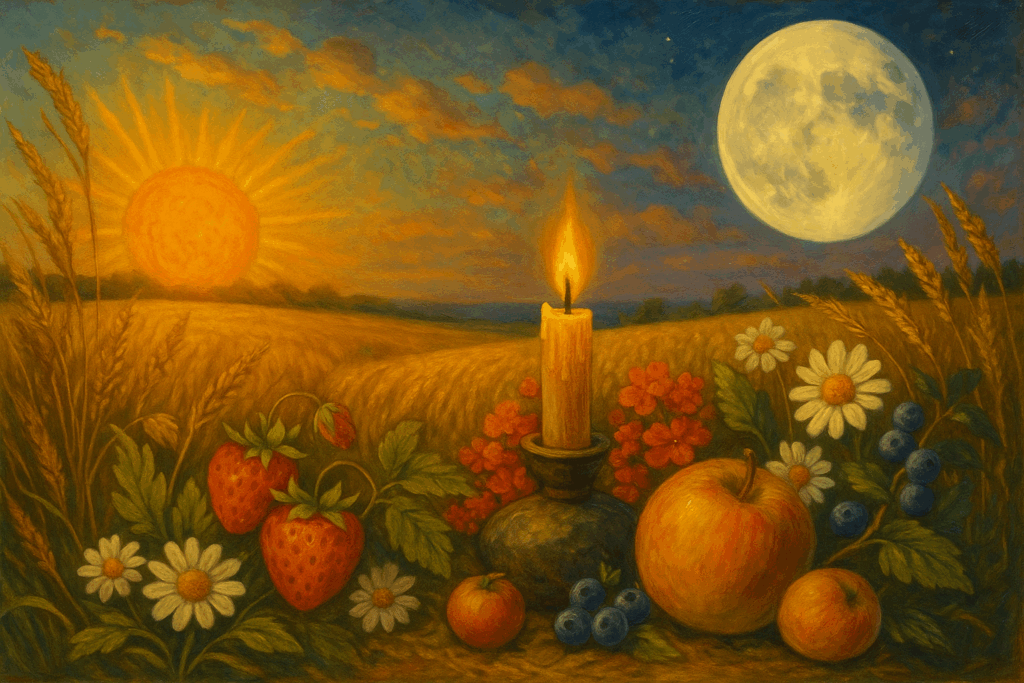
The seventeenth day of June arrives wrapped in quiet majesty — a pause before the great crescendo of the solstice. The light stretches impossibly long, lingering over the world as if reluctant to leave. Day and night seem to touch fingertips, neither one ready to yield. This is The Longest Twilight, a sacred hinge between ascent and culmination, a day devoted to balance, reflection, and the beauty of stillness. It is not a day of great action but of sacred rest — a moment to stand in the space between what has been and what will come, to breathe in the hush before the fire of Litha blazes at its full height.
In the ancient rhythms of the year, twilight has always been a liminal time, a borderland where the visible world and the unseen intermingle. The Longest Twilight magnifies that mystery — the hours between sunset and night extending like a dream, suffused with gold, rose, and indigo. The air is thick with potential, a shimmering silence that seems to hold every possibility at once. Pagans, druids, and mystics across traditions have recognized this moment as profoundly magical. It is neither light nor dark, but both — the alchemy of balance embodied in time itself.
The energy of this day teaches equilibrium. The Longest Twilight invites us to look inward and outward simultaneously, to find stillness amid abundance. The fields are ripe, the sun generous, yet the wise soul senses that the turning has already begun. The wheel will soon crest and begin its descent toward the dark half of the year. But there is no sorrow in that knowing — only reverence. For balance is not a fleeting truce between opposites; it is the eternal rhythm of the cosmos. The sun’s pause in the heavens mirrors the heart’s need to rest between breaths, to dwell for a moment in pure being before the next pulse of creation.
To honor this day, one must first slow down. Resist the call of busyness. Let your body move gently, your speech soften, your thoughts settle. If you can, watch the sunset in silence. Choose a high place or a quiet garden where you can see the horizon clearly. As the sun sinks, watch how the colors shift — how gold becomes amber, amber becomes rose, and rose dissolves into the violet of coming night. This is the twilight’s language — a lesson in transition, in the art of surrender. Whisper softly: “As the light lingers, so do I. Between day and night, I find peace.”
When the sun has slipped below the horizon but the sky still glows, begin a simple Twilight Meditation. Stand with your feet upon the earth, hands open at your sides. Feel the warmth fading from the air, the coolness of night rising to meet it. Breathe deeply, drawing both sensations into your body — the last heat of the day and the first breath of darkness. Imagine them merging at your heart, forming a sphere of silver-gold light. This is the essence of balance: the union of opposites creating harmony. Hold that image within you as long as you can, until your breath slows and your thoughts dissolve into quiet.
The twilight has long been associated with the meeting of realms — mortal and divine, seen and unseen, conscious and dream. It is said that during these lingering midsummer twilights, the boundary between worlds softens. The fae stir in their hidden places, ancestors draw near, and spirits of nature move more freely. Yet their energy tonight is not as playful or mischievous as on earlier nights; it is contemplative, serene. The world holds its breath, aware that something sacred is about to occur. You may feel that same awareness stirring within your own soul — a gentle readiness, a calm before transformation.
In your ritual or meditation, you may wish to work with symbols of balance and transition. The colors of this day are dusky violet, rose, and soft gold — hues that blend rather than contrast. The herbs are lavender for peace, sage for wisdom, and vervain for purification. The stones are moonstone, labradorite, or amber — those that capture the light within the shadow. Upon your altar, place one white candle and one black candle side by side. Between them, set a small bowl of water to reflect their flames. Light them as twilight fades and say:
“Light and dark, day and night,
Meet as lovers in your flight.
Flame and shadow, sun and moon,
Balance now and end too soon.
Teach me stillness, teach me grace,
To find the peace within this space.”
Let the candles burn as you meditate on the meaning of harmony in your own life. Ask yourself: Where am I striving too hard? Where have I forgotten to rest? What must I release to regain balance? The Longest Twilight offers clarity not through thought, but through feeling — a deep intuitive knowing that arises when we stop reaching and simply receive.
If you are called to movement rather than stillness, walk slowly as the stars begin to emerge. Let each step become a prayer of gratitude for the light that has guided you this far and for the darkness that will soon teach new lessons. Balance is not about control but trust — the faith that both sun and shadow serve the same purpose: growth.
In some old Celtic traditions, people would gather during these long twilights to sing soft songs and share simple feasts. There was laughter, but also reverence — an understanding that they were sitting upon the edge of something vast. You might recreate this sense of sacred community by lighting small lanterns or candles in your home or garden, each one representing a moment of peace you wish to preserve. Share food with loved ones or even with the spirits of the land — bread, milk, honey, or fruit, offered in gratitude for both the abundance and the balance of the season.
As night deepens and the first true stars claim the sky, extinguish your candles one by one, leaving only the reflection of their glow upon the water. Gaze into that reflection — light upon darkness, fire upon water — and see yourself mirrored there. Whisper: “As above, so below; as within, so without. In balance, I am whole.” Pour the water into the earth as offering and close your ritual in silence.
The Longest Twilight reminds us that stillness is not emptiness but fullness — a fullness so complete that it asks nothing of us but awareness. In a world that celebrates constant doing, the act of simply being becomes revolutionary, even holy. This day, poised between light and shadow, offers a rare and luminous lesson: that peace is found not at one extreme or the other, but in the meeting point where both dissolve into unity.
As you drift to rest beneath the vast summer sky, remember that the same balance that holds the sun at its height also lives within you. The tides of your breath, the rhythm of your heart, the rise and fall of your thoughts — all mirror the eternal equilibrium of the cosmos. The Longest Twilight is not a pause in time but a reminder of timelessness itself. You are part of that harmony, that unbroken dance of dusk and dawn. And in that knowing, peace is born.